
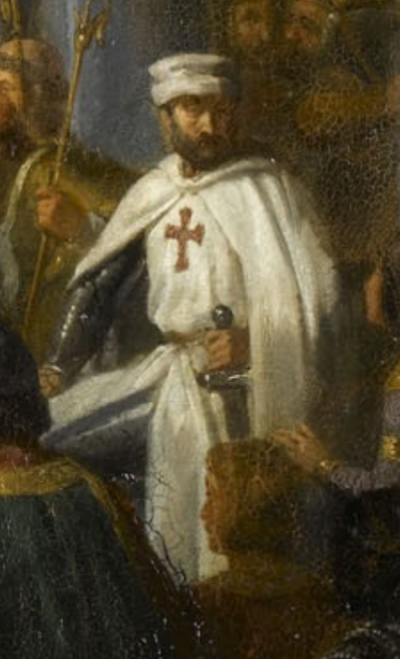
Everard des Barres
Everard des Barres was a Grand Master of the Knights Templar. Born 1113, in Meaux. Died 1174, in Clairvaux. Positions held include Grand Master of the Knights Templar (1149–1152) and provincial master of the Knights Templar (1143–1149).
Facts
10 facts · 0 confirmed by two sources · 2 cited · 8 from one source
Where this comes from
Papalocal keeps its own record. It started from these sources; what each one said is kept here as it was copied, so a change on their side never changes this page by itself. Tap one to read its version.
What Wikidata says · copied November 18, 2026 · revision 2553920580
- Described as
- Grand Master of the Knights Templar
- Born
- 1113
- Died
- 1174 · 1 reference
- Born in
- Meaux
- Died in
- Clairvaux
- Citizen of
- France
- Positions held
- Grand Master of the Knights Templar (1149–1152); provincial master of the Knights Templar (1143–1149)
- Father
- (Raoul) des Barres · 1 reference
- Siblings
- Guillaume I des Barres
- Religion
- Catholicism
- Wikipedias with a page
- 23
Wikidata item Q439794 (wikidata.org/wiki/Q439794), public domain (CC0). Copied November 18, 2026.
What Wikipedia says · copied November 18, 2026 · revision 1347062167
Everard des Barres (also Eberhard von Barres or Eberhard De Bären) (died after 1176) was the third Grand Master of the Knights Templar from 1147 to 1152.
Everard was Master of the Templars in France and accompanied Louis VII of France on the Second Crusade. In 1147, he was one of the three ambassadors that negotiated the passage of the Crusader army through the Byzantine Empire with Emperor Manuel I Komnenos. Upon the death of Robert de Craon in 1149, he was elected Grand Master of the Templar Order. His election was clearly influenced by the connection he had with Louis VII, since the Order needed to exploit those contacts and resources within France to maintain its military presence in the Holy Land. Everard later saved Louis during a battle with the Seljuk Turks in Pisidia.
According to the chronicler Odo of Deuil, Everard was extremely pious and valiant. He seems to have had a strong influence on Louis. During the crusade, in May 1148, Louis asked for his assistance securing a loan from the Templars to continue funding the French campaign. After the failure of the crusade at the Siege of Damascus in 1148, Louis returned to France, followed by Everard, who was in charge of the king's treasury. Everard's Templars stayed behind and helped defend Jerusalem against a Turkish raid in 1149.
Back in France, Everard resigned in 1152 and became a monk at Clairvaux alongside Bernard of Clairvaux. He was succeeded by Bernard de Tremelay. He died some time after 1176.
From the Wikipedia article “Everard des Barres” (en.wikipedia.org/wiki/Everard_des_Barres), by its contributors, under CC BY-SA 4.0 (creativecommons.org/licenses/by-sa/4.0/). Copied November 18, 2026; not changed.
Confirmed Two sources agree. Cited One source, and it names where it got it. One source One source, without a reference of its own. Sources disagree The sources disagree. We show the best-supported value and keep theirs below.
