
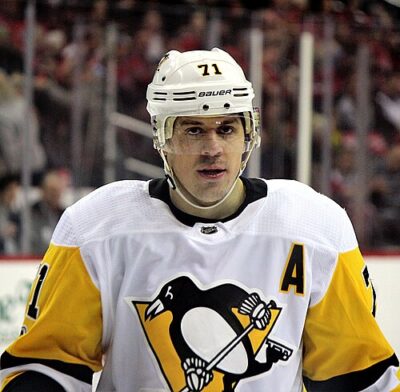
Evgeni Malkin
Evgeni Malkin is a Russian ice hockey player. Born July 31, 1986, in Magnitogorsk. Teams include Pittsburgh Penguins and Metallurg Magnitogorsk. Awards include Order of Honour, Hart Memorial Trophy and Art Ross Trophy (2 times).
Facts
18 facts · 1 confirmed by two sources · 7 cited · 10 from one source
Where this comes from
Papalocal keeps its own record. It started from these sources; what each one said is kept here as it was copied, so a change on their side never changes this page by itself. Tap one to read its version.
What Wikidata says · copied November 15, 2026 · revision 2569776332
- Described as
- Russian ice hockey player
- Other names
- Yevgeny Vladimirovich Malkin, Evgeni Vladimirovich Malkin, Geno Malkin
- Born
- July 31, 1986
- Born in
- Magnitogorsk
- Citizen of
- Soviet Union; Russia · 1 reference; United States · 1 reference
- Occupation
- ice hockey player · 1 reference
- Teams
- Pittsburgh Penguins; Metallurg Magnitogorsk
- Sport
- ice hockey · 1 reference
- Awards
- Order of Honour (2014); Hart Memorial Trophy (2012) · 1 reference; Art Ross Trophy (2 times) (2009, 2012) · 2 references; Calder Memorial Trophy (2007) · 2 references; Conn Smythe Trophy (2009) · 2 references; Ted Lindsay Award (2012) · 2 references; Honoured Master of Sports of Russia (2012)
- Spouse
- Anna Kasterova
- Height
- 1.90 m (6 ft 3 in)
- Wikipedias with a page
- 30
Wikidata item Q314433 (wikidata.org/wiki/Q314433), public domain (CC0). Copied November 15, 2026.
What Wikipedia says · copied November 15, 2026 · revision 1382374638
Evgeni Vladimirovich Malkin (Russian: Евге́ний Влади́мирович Ма́лкин, IPA: [jɪvˈɡʲenʲɪj ˈmalkʲɪn]; born 31 July 1986) is a Russian professional ice hockey player who is a centre and alternate captain for the Pittsburgh Penguins of the National Hockey League (NHL). Nicknamed "Geno", Malkin began his career with his hometown club Metallurg Magnitogorsk, playing for their junior and senior teams. He was then selected second overall in the 2004 NHL entry draft by the Pittsburgh Penguins, though an international transfer dispute delayed the start of his NHL career until 2006. Malkin is widely regarded as one of the greatest players of the modern NHL era and a quintessential piece of the Pittsburgh Penguins' salary cap era success.
After his first season with the Penguins, Malkin was awarded the Calder Memorial Trophy as the NHL's best rookie. In his second season, he helped lead Pittsburgh to the 2008 Stanley Cup Final and was a runner-up for the Hart Memorial Trophy, awarded to the NHL's most valuable player during the regular season. The following season saw Malkin win the Art Ross Trophy, awarded to the points leader in the NHL and again placed second for the Hart Trophy. He and the Penguins again reached the Stanley Cup Final, winning the Stanley Cup championship this time around. Malkin was awarded the Conn Smythe Trophy as most valuable player of the playoffs. In 2012, Malkin was awarded the Hart Trophy and Ted Lindsay Award, awarded to the best player as voted on by the players, after winning the Art Ross Trophy for the second time; his 12-point lead was the largest margin of victory since 1999.
Internationally, Malkin has competed for Russia in two IIHF World U18 Championships and three World Junior Championships, capturing one gold, two silvers and one bronze medal as a junior. In 2006, he was named tournament MVP. As a senior, he has played in four IIHF World Championships, winning gold twice and being named the tournament MVP for the 2012 event. Malkin has played for Russia in three Winter Olympic Games: Turin in 2006, Vancouver in 2010 and Sochi in 2014, respectively. In 2020, he was named to the IIHF All-Time Russia Team.
- Born, in its opening lines
- July 31, 1986
From the Wikipedia article “Evgeni Malkin” (en.wikipedia.org/wiki/Evgeni_Malkin), by its contributors, under CC BY-SA 4.0 (creativecommons.org/licenses/by-sa/4.0/). Copied November 15, 2026; not changed.
Confirmed Two sources agree. Cited One source, and it names where it got it. One source One source, without a reference of its own. Sources disagree The sources disagree. We show the best-supported value and keep theirs below.
