
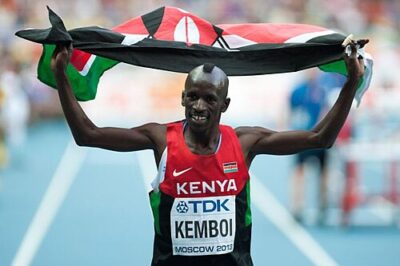
Ezekiel Kemboi is a Kenyan runner. Born May 25, 1982, in Marakwet District.
Facts
7 facts · 1 confirmed by two sources · 0 cited · 6 from one source
Where this comes from
Papalocal keeps its own record. It started from these sources; what each one said is kept here as it was copied, so a change on their side never changes this page by itself. Tap one to read its version.
What Wikidata says · copied November 16, 2026 · revision 2568842633
- Described as
- Kenyan runner
- Other names
- Ezekiel Kemboi Cheboi
- Born
- May 25, 1982 · 2 references
- Born in
- Marakwet District
- Citizen of
- Kenya
- Occupation
- steeplechase runner; athletics competitor
- Sport
- athletics
- Height
- 1.67 m (5 ft 6 in)
- Wikipedias with a page
- 36
Wikidata item Q1677 (wikidata.org/wiki/Q1677), public domain (CC0). Copied November 16, 2026.
What Wikipedia says · copied November 16, 2026 · revision 1381199122
Ezekiel Kemboi Cheboi (born 25 May 1982) is a Kenyan professional athlete, winner of the 3000 metres steeplechase at the 2004 Summer Olympics, the 2009 World Championships, the 2011 World Championships, the 2012 Summer Olympics, the 2013 World Championships and the 2015 World Championships. His 3000 m steeplechase best of 7:55.76 set at Monaco in 2011 places him as the seventh fastest of all time. This time is also the fastest non-winning time in history. He is one of only five men to have won both Olympic and World golds in the event, along with Reuben Kosgei, Brimin Kipruto, Conseslus Kipruto and Soufiane El Bakkali. He and El Bakkali are the only multiple gold medalists in both. He is the only athlete to have won four world championships in the steeplechase (which he won consecutively). He is one of only three athletes to have won two Olympic titles in the event; the other two being Volmari Iso-Hollo and Soufiane El Bakkali.
- Born, in its opening lines
- May 25, 1982
From the Wikipedia article “Ezekiel Kemboi” (en.wikipedia.org/wiki/Ezekiel_Kemboi), by its contributors, under CC BY-SA 4.0 (creativecommons.org/licenses/by-sa/4.0/). Copied November 16, 2026; not changed.
Confirmed Two sources agree. Cited One source, and it names where it got it. One source One source, without a reference of its own. Sources disagree The sources disagree. We show the best-supported value and keep theirs below.
