
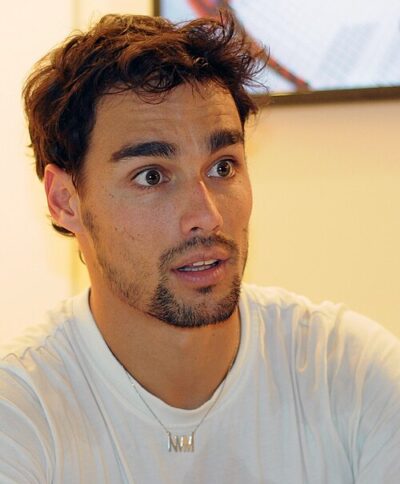
Fabio Fognini is an Italian tennis player. Born May 24, 1987, in Sanremo. Awards include Gold Collar for Sports Merit.
Facts
9 facts · 1 confirmed by two sources · 4 cited · 4 from one source
Where this comes from
Papalocal keeps its own record. It started from these sources; what each one said is kept here as it was copied, so a change on their side never changes this page by itself. Tap one to read its version.
What Wikidata says · copied November 16, 2026 · revision 2517627992
- Described as
- Italian tennis player (born 1987)
- Born
- May 24, 1987 · 2 references
- Born in
- Sanremo · 1 reference
- Citizen of
- Italy · 1 reference
- Occupation
- tennis player (2004–) · 1 reference
- Sport
- tennis · 1 reference
- Awards
- Gold Collar for Sports Merit · 1 reference
- Spouse
- Flavia Pennetta (2016–)
- Height
- 1.78 m (5 ft 10 in)
- Website
- http://www.fabiofognini.eu
- Wikipedias with a page
- 37
Wikidata item Q251980 (wikidata.org/wiki/Q251980), public domain (CC0). Copied November 16, 2026.
What Wikipedia says · copied November 16, 2026 · revision 1385016497
Fabio Fognini (Italian pronunciation: [ˈfaːbjo foɲˈɲiːni]; born 24 May 1987) is an Italian former professional tennis player. He has a career-high ATP ranking of world No. 9 achieved on 15 July 2019. Fognini's most successful surface is red clay, where he has won eight of his nine ATP singles titles, most notably at the 2019 Monte-Carlo Masters. He also reached the quarterfinals of the 2011 French Open. Together with Simone Bolelli, Fognini won the 2015 Australian Open doubles championship, becoming the first all-Italian men's pair to win a Grand Slam title in the Open Era. He entered the top 10 at 33 years old, holding the record of the oldest player to become a top ten.
- Born, in its opening lines
- May 24, 1987
From the Wikipedia article “Fabio Fognini” (en.wikipedia.org/wiki/Fabio_Fognini), by its contributors, under CC BY-SA 4.0 (creativecommons.org/licenses/by-sa/4.0/). Copied November 16, 2026; not changed.
Confirmed Two sources agree. Cited One source, and it names where it got it. One source One source, without a reference of its own. Sources disagree The sources disagree. We show the best-supported value and keep theirs below.
