
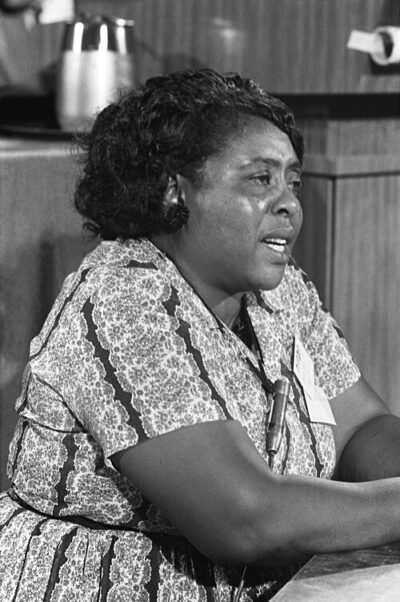
Fannie Lou Hamer
Fannie Lou Hamer was an American civil rights activist. Born October 6, 1917, in Montgomery County. Died March 14, 1977, in Mound Bayou. Awards include National Women's Hall of Fame and Presidential Medal of Freedom.
Facts
23 facts · 2 confirmed by two sources · 18 cited · 3 from one source
Where this comes from
Papalocal keeps its own record. It started from these sources; what each one said is kept here as it was copied, so a change on their side never changes this page by itself. Tap one to read its version.
What Wikidata says · copied November 15, 2026 · revision 2562936710
- Described as
- American civil rights activist (1917–1977)
- Other names
- Fannie Lou Townsend Hamer, Fannie Lou Townsend
- Born
- October 6, 1917 · 7 references
- Died
- March 14, 1977 · 5 references
- Born in
- Montgomery County · 1 reference
- Died in
- Mound Bayou · 2 references
- Cause of death
- heart failure · 1 reference
- Name at birth
- Fannie Lou Townsend · 1 reference
- Citizen of
- United States
- Occupation
- politician; autobiographer · 1 reference; sharecropper · 1 reference; political activist · 1 reference
- Political party
- Mississippi Freedom Democratic Party (1964–) · 2 references
- Member of
- National Women's Political Caucus (1971–) · 2 references; civil rights movement · 1 reference; Student Nonviolent Coordinating Committee · 1 reference
- Awards
- National Women's Hall of Fame (1993) · 1 reference; Presidential Medal of Freedom (2025) · 1 reference
- Field
- human rights · 1 reference; minority rights · 1 reference; women's rights · 1 reference; activism · 1 reference; active suffrage · 1 reference
- Spouse
- Perry Hamer · 1 reference
- Wikipedias with a page
- 30
Wikidata item Q438438 (wikidata.org/wiki/Q438438), public domain (CC0). Copied November 15, 2026.
What Wikipedia says · copied November 15, 2026 · revision 1382803893
Fannie Lou Hamer (; née Townsend; October 6, 1917 – March 14, 1977) was an American voting and women's rights activist, community organizer, and leader of the civil rights movement. She was the vice-chair of the Freedom Democratic Party, which she represented at the 1964 Democratic National Convention. Hamer also organized Mississippi's Freedom Summer along with the Student Nonviolent Coordinating Committee (SNCC). She was a co-founder of the National Women's Political Caucus, an organization created to recruit, train, and support women of all races who sought election to government offices.
Hamer began her civil rights activism in 1962, continuing it until her health declined nine years later. She was known for her use of spiritual hymns and biblical quotes, and for her resilience in leading the civil rights movement for black women in Mississippi. She was threatened, harassed, shot at, and assaulted by racists, including members of the police, while she was trying to register to vote. She later helped and encouraged thousands of Black people in Mississippi to become registered voters, and assisted hundreds of disenfranchised people in her area through her work in programs such as the Freedom Farm Cooperative. She ran for the U.S. House in 1964, losing to Jamie Whitten, and she ran for the Mississippi State Senate in 1971. In 1970, she led legal action against the government of Sunflower County, Mississippi, for continued illegal segregation.
Hamer died on March 14, 1977, aged 59, in Mound Bayou, Mississippi. Her memorial service was widely attended and U.S. Ambassador to the United Nations Andrew Young delivered the eulogy. She was inducted into the National Women's Hall of Fame in 1993. On January 4, 2025, President Joe Biden posthumously awarded Hamer the Presidential Medal of Freedom.
- Born, in its opening lines
- October 6, 1917
- Died, in its opening lines
- March 14, 1977
From the Wikipedia article “Fannie Lou Hamer” (en.wikipedia.org/wiki/Fannie_Lou_Hamer), by its contributors, under CC BY-SA 4.0 (creativecommons.org/licenses/by-sa/4.0/). Copied November 15, 2026; not changed.
Confirmed Two sources agree. Cited One source, and it names where it got it. One source One source, without a reference of its own. Sources disagree The sources disagree. We show the best-supported value and keep theirs below.
