
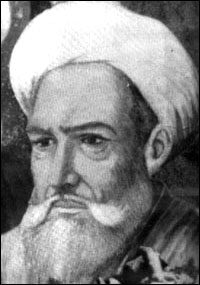
Farabi
Farabi was the 10th century Persian philosopher and jurist. Born 870, in Otrar. Died 951, in Damascus. Known for Ara Ahl al Madina al Fadila, message in the mind and Alfarabi's Philosophy of Plato and Aristotle.
Facts
26 facts · 1 confirmed by two sources · 4 cited · 20 from one source · 1 where the sources disagree
What’s different
- Born: we show 870 (Sources disagree). Wikipedia says December 14, 950
Where this comes from
Papalocal keeps its own record. It started from these sources; what each one said is kept here as it was copied, so a change on their side never changes this page by itself. Tap one to read its version.
What Wikidata says · copied November 16, 2026 · revision 2568749660
- Described as
- 10th century Persian philosopher and jurist
- Other names
- Alpharabius, Abu Nasr al-Farabi, Alfarabi
- Born
- 870 · 3 references
- Died
- 951 · 1 reference
- Born in
- Otrar · 1 reference
- Died in
- Damascus · 3 references
- Buried in
- Bab al-Saghir Cemetery
- Citizen of
- Abbasid Caliphate
- Occupation
- philosopher · 1 reference; physicist; music theorist; logician; astronomer; social scientist; musicologist
- Known for
- Ara Ahl al Madina al Fadila; message in the mind; Alfarabi's Philosophy of Plato and Aristotle; Kitab al-Musiqa al-Kabir; Enumeration of sciences
- Field
- natural history; metaphysics; mathematics; logic · 1 reference; astronomy; medicine
- Religion
- Islam · 1 reference; Shia Islam · 1 reference
- Wikipedias with a page
- 99
Wikidata item Q160460 (wikidata.org/wiki/Q160460), public domain (CC0). Copied November 16, 2026.
What Wikipedia says · copied November 16, 2026 · revision 1384776038
Abu Nasr Muhammad al-Farabi (Arabic: أبو نصر محمد الفارابي, romanized: Abū Naṣr Muḥammad al-Fārābī; c. 870 – 14 December 950–12 January 951), known in the Latin West as Alpharabius, was an early Islamic philosopher and music theorist. He has been designated as "Father of Islamic Neoplatonism", and the "Founder of Islamic Political Philosophy".
Al-Farabi's fields of philosophical interest included—but were not limited to—philosophy of society and religion; philosophy of language and logic; psychology and epistemology; metaphysics, political philosophy, and ethics. He was an expert in both practical musicianship and music theory, and although he was not intrinsically a scientist, his works incorporate astronomy, mathematics, cosmology, and physics.
Al-Farabi is credited as the first Muslim who presented philosophy as a coherent system in the Islamic world, and created a philosophical system of his own, which went far beyond the scholastic interests of his Greco-Roman Neoplatonism and Syriac Aristotelian precursors. That he was more than a pioneer in Islamic philosophy is evident from later writers calling him the "Second Master", with Aristotle as the first.
Philosophers influenced by Al-Farabi include Yahya ibn Adi, Abu Sulayman Sijistani, Abu al-Hassan al-Amiri, and Abu Hayyan al-Tawhidi; Avicenna, Suhrawardi, and Mulla Sadra; Avempace, Ibn Tufail, and Averroes; Maimonides, Albertus Magnus, and Leo Strauss. He was known in the Latin West, as well as the Islamic world.
- Born, in its opening lines
- December 14, 950
- Died, in its opening lines
- January 12, 951
From the Wikipedia article “Al-Farabi” (en.wikipedia.org/wiki/Al-Farabi), by its contributors, under CC BY-SA 4.0 (creativecommons.org/licenses/by-sa/4.0/). Copied November 16, 2026; not changed.
Confirmed Two sources agree. Cited One source, and it names where it got it. One source One source, without a reference of its own. Sources disagree The sources disagree. We show the best-supported value and keep theirs below.
