
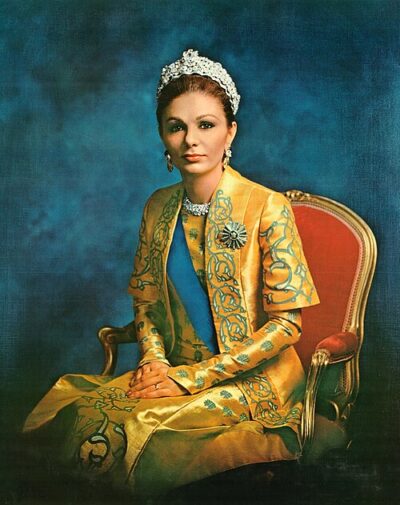
Farah Pahlavi
Farah Pahlavi is a queen/empress consort of Iran from 1959 to 1979. Born October 14, 1938, in Tehran. Positions held include empress consort. Educated at Special School of Architecture and Jeanne d'Arc School. Awards include Grand Cross of the Legion of Honour, Knight Grand Cross with Collar of the Order of Merit of the Italian Republic and Grand Cross of the Order of Isabella the Catholic.
Facts
44 facts · 1 confirmed by two sources · 8 cited · 35 from one source
Where this comes from
Papalocal keeps its own record. It started from these sources; what each one said is kept here as it was copied, so a change on their side never changes this page by itself. Tap one to read its version.
What Wikidata says · copied November 16, 2026 · revision 2567975271
- Described as
- queen/empress consort of Iran from 1959 to 1979
- Other names
- Farah Diba, Farah Diba Pahlavi
- Born
- October 14, 1938 · 7 references
- Born in
- Tehran · 2 references
- Name at birth
- Fərəh Diba
- Citizen of
- Iran; France
- Occupation
- writer; translator; architect; politician · 1 reference; queen consort
- Positions held
- empress consort
- Education
- Special School of Architecture; Jeanne d'Arc School; Razi High School
- Member of
- Académie des beaux-arts; Mohammad Reza Pahlavi and Farah Pahlavi
- Awards
- Grand Cross of the Legion of Honour; Knight Grand Cross with Collar of the Order of Merit of the Italian Republic (1974); Grand Cross of the Order of Isabella the Catholic; Order of the Crown of the Realm; Steiger Award; Grand Cross Special Class of the Order of Merit of the Federal Republic of Germany (1967); Grand Star of the Decoration for Services to the Republic of Austria (1965) · 1 reference; Knight of the Order of the Elephant (1963) · 1 reference; Knight Grand Cross of the Order of St. Olav (1965) · 1 reference; Order of the Smile; Order of Aryamehr · 1 reference; anniversary medal at the occasion of the 2500th anniversary of the founding of the Iranian Empire · 1 reference; Shah Reza Pahlavi Investiture Meda · 1 reference; Order of the Netherlands Lion · 1 reference; Order of Leopold · 1 reference
- Spouse
- Mohammad Reza I of Iran (1959–1980) · 1 reference
- Children
- Reza Pahlavi · 1 reference; Farahnaz Pahlavi; Ali Reza Pahlavi · 1 reference; Leila Pahlavi · 1 reference
- Father
- Sohrab Diba
- Mother
- Farideh Ghotbi · 2 references
- Religion
- Shia Islam
- Lived in
- Paris (–1959); Tehran (1959–1979); Egypt (1979–); United States
- Website
- http://www.farahpahlavi.org/
- Wikipedias with a page
- 65
Wikidata item Q164111 (wikidata.org/wiki/Q164111), public domain (CC0). Copied November 16, 2026.
What Wikipedia says · copied November 16, 2026 · revision 1382838475
Farah Pahlavi (Persian: فرح پهلوی; née Diba [دیبا]; born 14 October 1938) is a member of the Pahlavi dynasty. She is the last queen and empress (شهبانو, Shahbânu) of Iran, and is the third wife and widow of the last shah of Iran, Mohammad Reza Pahlavi.
She was born into a prosperous Iranian family whose fortunes were diminished after her father's early death. While studying architecture in Paris, she was introduced to the Shah at the Iranian embassy, and they were married in December 1959. The Shah's first two marriages had not produced a son—necessary for royal succession—resulting in great rejoicing at the birth of Crown Prince Reza in October of the following year. As a philanthropist, she advanced the welfare of Iranian civil society through the establishment of charities and founded Iran's Shiraz University, Iran's first American-style university, increasing the number of women students. She also facilitated the recall of Iranian antiquities from museums abroad.
By 1978, growing anti-imperial unrest fueled by growing inequality between rich and poor throughout Iran was showing clear signs of impending revolution, prompting Farah and the Shah to leave the country in January 1979 under the threat of a death sentence. For that reason, most countries were reluctant to harbor them, with Anwar Sadat's Egypt being an exception. Facing execution should he return, and in ill health, Mohammad Reza died in exile in July 1980. Farah led the Pahlavi dynasty as regent until October 1980, when her son, Reza Pahlavi, declared himself Shah of Iran, ending Farah's regency.
Since 1979, she has lived in exile, primarily in the United States and France. She has been a vocal supporter of the Iranian protestors and critic of the Iranian Islamic regime in the wake of the killing of 22-year-old Mahsa Amini while in the custody of Iranian hijab police in 2022, the subsequent execution of Iranian protester Mohsen Shekari later that year, and the 2025–2026 Iranian protests.
- Born, in its opening lines
- October 14, 1938
From the Wikipedia article “Farah Pahlavi” (en.wikipedia.org/wiki/Farah_Pahlavi), by its contributors, under CC BY-SA 4.0 (creativecommons.org/licenses/by-sa/4.0/). Copied November 16, 2026; not changed.
Confirmed Two sources agree. Cited One source, and it names where it got it. One source One source, without a reference of its own. Sources disagree The sources disagree. We show the best-supported value and keep theirs below.
