
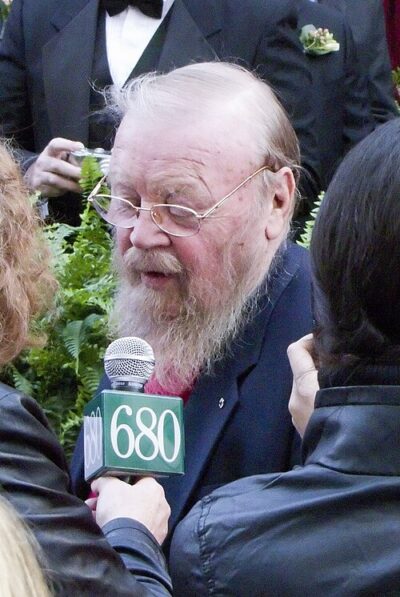
Farley Mowat
Farley Mowat was a Canadian writer and environmentalist. Born May 12, 1921, in Belleville. Died May 6, 2014, in Cobourg. Known for Never Cry Wolf, People of the Deer and Lost in the Barrens. Educated at University of Toronto and Richmond Hill High School. Awards include Officer of the Order of Canada, Anisfield-Wolf Book Awards and Canada's Walk of Fame.
Facts
26 facts · 2 confirmed by two sources · 5 cited · 19 from one source
Where this comes from
Papalocal keeps its own record. It started from these sources; what each one said is kept here as it was copied, so a change on their side never changes this page by itself. Tap one to read its version.
What Wikidata says · copied November 15, 2026 · revision 2565602580
- Described as
- Canadian writer and environmentalist (1921–2014)
- Other names
- Farley McGill Mowat
- Born
- May 12, 1921 · 7 references
- Died
- May 6, 2014 · 6 references
- Born in
- Belleville · 1 reference
- Died in
- Cobourg
- Buried in
- St. Mark's Church
- Citizen of
- Canada
- Occupation
- writer · 1 reference; environmentalist; biologist · 1 reference; scientific collector · 1 reference
- Education
- University of Toronto; Richmond Hill High School
- Known for
- Never Cry Wolf; People of the Deer; Lost in the Barrens; Curse of the Viking Grave
- Awards
- Officer of the Order of Canada; Anisfield-Wolf Book Awards (1953); Canada's Walk of Fame (2010) · 1 reference; Canadian Library Association Book of the Year for Children Award (1958); Stephen Leacock Memorial Medal for Humour (1970)
- Field
- environmental science · 1 reference
- Spouse
- Claire Mowat
- Father
- Angus McGill Mowat · 1 reference
- Mother
- Helen Anne Lilian Thomson · 1 reference
- Military rank
- captain · 1 reference
- Wikipedias with a page
- 26
Wikidata item Q966679 (wikidata.org/wiki/Q966679), public domain (CC0). Copied November 15, 2026.
What Wikipedia says · copied November 15, 2026 · revision 1385277374
Farley McGill Mowat (May 12, 1921 – May 6, 2014) was a Canadian writer and environmentalist. His works were translated into 52 languages, and he sold more than 17 million books. He achieved fame with the publication of his books on the Canadian north, such as People of the Deer (1952) and Never Cry Wolf (1963). The latter, an account of his experiences with wolves in the Arctic, was made into a film of the same name released in 1983. For his body of work as a writer he won the annual Vicky Metcalf Award for Children's Literature in 1970.
Mowat's advocacy for environmental causes earned him praise, but his admission, after some of his books' claims had been debunked, that he "never let the facts get in the way of the truth" earned harsh criticism, while his supporters noted that the literary "exaggerations… [in] his books almost single-handedly drew attention to the plight of the Inuit and serious environmental issues, bringing about substantive changes of policy in Ottawa". Descriptions of Mowat refer to his "commitment to ideals" and "poetic descriptions and vivid images" as well as his strong antipathies, which led him to produce "ridicule, lampoons and, at times, evangelical condemnation".
- Born, in its opening lines
- May 12, 1921
- Died, in its opening lines
- May 6, 2014
From the Wikipedia article “Farley Mowat” (en.wikipedia.org/wiki/Farley_Mowat), by its contributors, under CC BY-SA 4.0 (creativecommons.org/licenses/by-sa/4.0/). Copied November 15, 2026; not changed.
Confirmed Two sources agree. Cited One source, and it names where it got it. One source One source, without a reference of its own. Sources disagree The sources disagree. We show the best-supported value and keep theirs below.
