
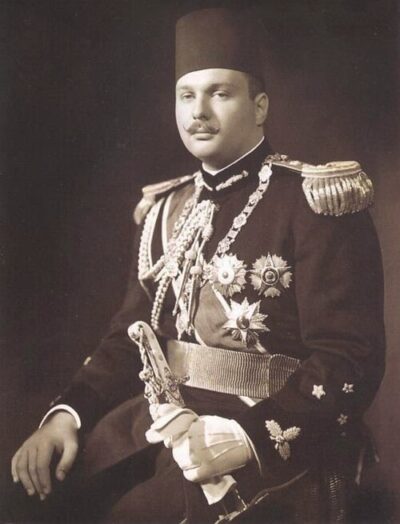
Farouk I of Egypt
Farouk I of Egypt was a King of Egypt 1936 to 1952. Born February 11, 1920, in Abdeen Palace. Died March 18, 1965, in Rome. Positions held include King of Egypt (1936–1952). Educated at Royal Military Academy, Woolwich. Awards include Collar of the Order of Isabella the Catholic, Order of the White Eagle and Order of Muhammad Ali.
Facts
47 facts · 2 confirmed by two sources · 7 cited · 38 from one source
What’s different
- Born: we show February 11, 1920 (Confirmed). Wikidata also lists 1920
- Died: we show March 18, 1965 (Confirmed). Wikidata also lists 1965
Where this comes from
Papalocal keeps its own record. It started from these sources; what each one said is kept here as it was copied, so a change on their side never changes this page by itself. Tap one to read its version.
What Wikidata says · copied November 16, 2026 · revision 2565058608
- Described as
- King of Egypt 1936 to 1952
- Other names
- King Farouk I of Egypt
- Born
- February 11, 1920 · 7 references; 1920 · 1 reference
- Died
- March 18, 1965 · 4 references; 1965 · 1 reference
- Born in
- Abdeen Palace
- Died in
- Rome · 1 reference
- Buried in
- Al-Rifa'i Mosque
- Cause of death
- poisoning
- Citizen of
- Sultanate of Egypt (–1922); Kingdom of Egypt (1922–1953); Republic of Egypt (1953–1958); United Arab Republic (1958–)
- Occupation
- politician; coin collecting; king · 1 reference
- Positions held
- King of Egypt (1936–1952)
- Education
- Royal Military Academy, Woolwich
- Member of
- Egyptian Royal Family
- Awards
- Collar of the Order of Isabella the Catholic (1951) · 1 reference; Order of the White Eagle; Order of Muhammad Ali; Order of the Nile; Royal Order of the Seraphim; Order of the Umayyads; Order of Saints Cyril and Methodius Equal-to-apostles; Grand Order of the Hashimites; Order of Solomon; Order of the Royal House of Chakri; Order of the Most Holy Annunciation; Order of Pahlavi; Order of the Supreme Sun; Order of al-Hussein bin Ali; Supreme Order of the Renaissance
- Spouse
- Farida of Egypt (1938–1948) · 1 reference; Narriman Sadek (1951–1954)
- Children
- Princess Farial of Egypt; Princess Fawzia Farouk of Egypt · 1 reference; Princess Fadia of Egypt · 1 reference; Fuad II of Egypt · 2 references
- Father
- Fuad I of Egypt · 1 reference
- Mother
- Nazli Sabri · 1 reference
- Siblings
- Prince Ismail Fuad Muhammad Ali; Princess Fawkia Fuad of Egypt; Princess Faiza Fuad of Egypt; Princess Faika Fuad of Egypt; Princess Fathia Fuad of Egypt; Princess Fawzia Fuad of Egypt
- Religion
- Sunni Islam
- Military rank
- field marshal
- Wikipedias with a page
- 64
Wikidata item Q213001 (wikidata.org/wiki/Q213001), public domain (CC0). Copied November 16, 2026.
What Wikipedia says · copied November 16, 2026 · revision 1384279689
Farouk I (; Arabic: فاروق الأول, romanized: Fārūq al-Awwal; 11 February 1920 – 18 March 1965) was the tenth ruler of Egypt from the Muhammad Ali dynasty and the penultimate King of Egypt and the Sudan, succeeding his father, Fuad I, in 1936 and reigning until his overthrow in a military coup in 1952.
As King, Farouk was known for his extravagant playboy lifestyle. While initially popular, his reputation eroded due to the corruption and incompetence of his government. He was overthrown in the 1952 coup d'état and forced to abdicate in favour of his six-month-old son, Ahmed Fuad, who succeeded him as Fuad II. He in turn formally reigned as the last King of Egypt and the Sudan from July 1952 until the abolition of the Egyptian monarchy in June 1953. Farouk died in exile in Italy in 1965.
His sister, Princess Fawzia bint Fuad, was the first wife and consort of the Shah of Iran, Mohammad Reza Pahlavi.
- Born, in its opening lines
- February 11, 1920
- Died, in its opening lines
- March 18, 1965
From the Wikipedia article “Farouk of Egypt” (en.wikipedia.org/wiki/Farouk_of_Egypt), by its contributors, under CC BY-SA 4.0 (creativecommons.org/licenses/by-sa/4.0/). Copied November 16, 2026; not changed.
Confirmed Two sources agree. Cited One source, and it names where it got it. One source One source, without a reference of its own. Sources disagree The sources disagree. We show the best-supported value and keep theirs below.
