
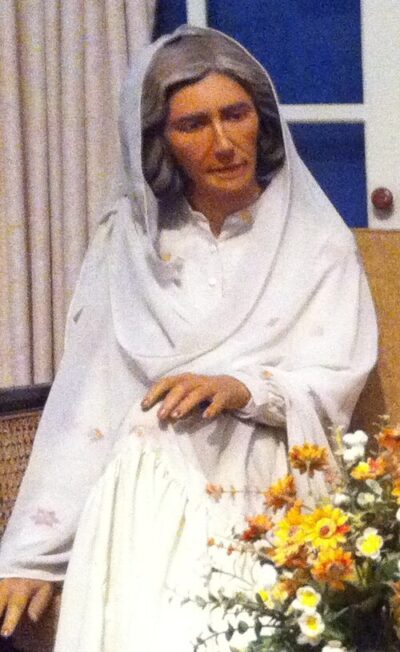
Fatima Jinnah
Fatima Jinnah was a Pakistani dental surgeon, biographer and stateswoman. Born July 31, 1893, in Karachi. Died July 9, 1967, in Karachi. Positions held include Leader of the Opposition (1960–1967). Educated at University of Calcutta.
Facts
18 facts · 2 confirmed by two sources · 4 cited · 12 from one source
Where this comes from
Papalocal keeps its own record. It started from these sources; what each one said is kept here as it was copied, so a change on their side never changes this page by itself. Tap one to read its version.
What Wikidata says · copied November 16, 2026 · revision 2568914080
- Described as
- Pakistani dental surgeon, biographer and stateswoman (1893–1967)
- Born
- July 31, 1893 · 2 references
- Died
- July 9, 1967 · 2 references
- Born in
- Karachi · 1 reference
- Died in
- Karachi · 1 reference
- Buried in
- Mazar-e-Quaid
- Citizen of
- Pakistan; British Raj
- Occupation
- dentist; politician · 1 reference; biographer; writer
- Positions held
- Leader of the Opposition (1960–1967)
- Political party
- All India Muslim League
- Education
- University of Calcutta
- Mother
- Mitthibai Jinnahbhai
- Siblings
- Mohammad Ali Jinnah · 1 reference
- Religion
- Shia Islam; Islam · 1 reference
- Wikipedias with a page
- 47
Wikidata item Q464947 (wikidata.org/wiki/Q464947), public domain (CC0). Copied November 16, 2026.
What Wikipedia says · copied November 16, 2026 · revision 1381881094
Fatima Jinnah (31 July 1893 – 9 July 1967) was a Pakistani politician, stateswoman, author, and activist. She was the younger sister of Muhammad Ali Jinnah, the founder and first governor-general of Pakistan.
After obtaining a dental degree from the University of Calcutta in 1923, she became the first woman to qualify as a dentist in British India. She was a close associate and adviser to her brother, accompanying him throughout the Pakistan Movement and participating in the activities of the All-India Muslim League. After the independence of Pakistan, she assisted in the settlement of Muhajirs and established the Women's Relief Committee, which later evolved into the All Pakistan Women's Association. She remained the closest confidant of her brother until his death. After his death, Fatima was prevented from addressing the nation until 1951; her 1951 radio address was interrupted, which many believed was an attempt by the Liaquat Ali Khan government to censor her. She wrote the book My Brother in 1955, but it was only published 32 years later, in 1987. According to journalist Akhtar Baloch, before its publication, Sharif al Mujahid removed several pages, stating that they were "against the ideology of Pakistan".
In 1964–65, Fatima accepted the nomination of the Combined Opposition Parties (COP) to contest the 1965 presidential election against President Ayub Khan. During her campaign, she criticised Ayub's military rule and called for the restoration of democracy and civil rights. Although Ayub won through the Basic democracy electoral college system, Fatima received strong support in East Pakistan and urban centres, and the opposition alleged widespread electoral malpractice. Following the election, she largely withdrew from public life and spent her remaining years at Mohatta Palace in Karachi.
Fatima died in Karachi on 9 July 1967, sparking controversy with rumours of unnatural causes. Although her nephew, Akbar Pirbhai, called for an inquiry, no official report was issued. Nearly half a million people attended her funeral in Karachi. According to Akbar Ahmed, her legacy is associated with her opposition to military rule and her role as a symbol of democratic Pakistan. She is commonly known as Madar-e-Millat ("Mother of the Nation") and Khatun-e-Pakistan ("Lady of Pakistan"), and numerous institutions and public spaces in Pakistan have been named in her honour.
- Born, in its opening lines
- July 31, 1893
- Died, in its opening lines
- July 9, 1967
From the Wikipedia article “Fatima Jinnah” (en.wikipedia.org/wiki/Fatima_Jinnah), by its contributors, under CC BY-SA 4.0 (creativecommons.org/licenses/by-sa/4.0/). Copied November 16, 2026; not changed.
Confirmed Two sources agree. Cited One source, and it names where it got it. One source One source, without a reference of its own. Sources disagree The sources disagree. We show the best-supported value and keep theirs below.
