
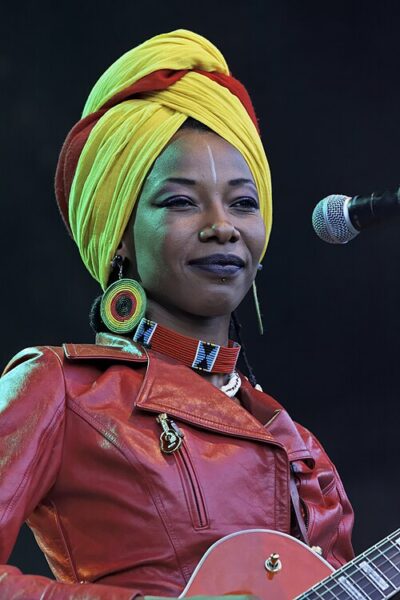
Fatoumata Diawara
Fatoumata Diawara is a Malian musician and actress. Born February 21, 1982, in Abidjan. Awards include OkayAfrica 100 Women.
Facts
18 facts · 1 confirmed by two sources · 6 cited · 11 from one source
Where this comes from
Papalocal keeps its own record. It started from these sources; what each one said is kept here as it was copied, so a change on their side never changes this page by itself. Tap one to read its version.
What Wikidata says · copied November 16, 2026 · revision 2558189977
- Described as
- Malian musician and actress
- Other names
- Kanou
- Born
- February 21, 1982 · 4 references
- Born in
- Abidjan · 1 reference
- Citizen of
- Mali
- Occupation
- singer-songwriter; actor · 3 references; guitarist; singer · 1 reference; musician · 1 reference; songwriter · 1 reference
- Member of
- Lamomali
- Genre
- folk music · 1 reference; Wassoulou music; desert blues
- Instrument
- voice
- Record label
- World Circuit; Nonesuch Records
- Awards
- OkayAfrica 100 Women (2017)
- Website
- http://fatoumatadiawara.com/en/
- Wikipedias with a page
- 32
Wikidata item Q707255 (wikidata.org/wiki/Q707255), public domain (CC0). Copied November 16, 2026.
What Wikipedia says · copied November 16, 2026 · revision 1376237260
Fatoumata Diawara (Bambara: ߝߊ߫ߕߎߡߕߊ ߖߊ߯ߥߙߊ߫, romanized: Fatumta Jawara, born 21 February 1982) is a Malian singer-songwriter and actress currently living in France.
Diawara began her career as an actress in theatre and in film, including Genesis (1999), Sia, The Dream of the Python (2001) and Timbuktu (2014). She later launched a career in music, collaborating with numerous artists and releasing three studio albums beginning with 2011 debut Fatou. Diawara's music combines traditional Wassoulou with international styles.
- Born, in its opening lines
- February 21, 1982
From the Wikipedia article “Fatoumata Diawara” (en.wikipedia.org/wiki/Fatoumata_Diawara), by its contributors, under CC BY-SA 4.0 (creativecommons.org/licenses/by-sa/4.0/). Copied November 16, 2026; not changed.
Confirmed Two sources agree. Cited One source, and it names where it got it. One source One source, without a reference of its own. Sources disagree The sources disagree. We show the best-supported value and keep theirs below.
