
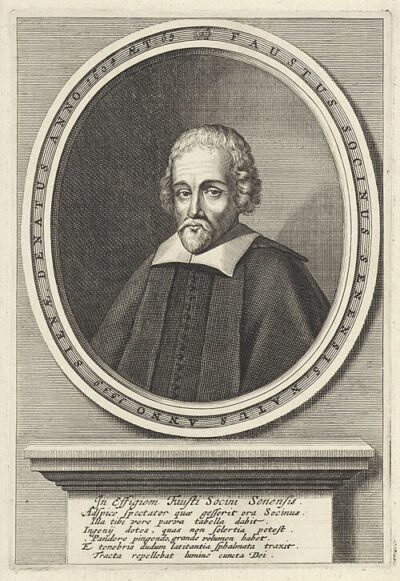
Fausto Sozzini was an Italian theologian. Born December 5, 1539, in Siena. Died March 4, 1604, in Lusławice, Lesser Poland Voivodeship.
Facts
11 facts · 2 confirmed by two sources · 2 cited · 7 from one source
What’s different
- Died: we show March 4, 1604 (Confirmed). Wikidata also lists March 3, 1604
Where this comes from
Papalocal keeps its own record. It started from these sources; what each one said is kept here as it was copied, so a change on their side never changes this page by itself. Tap one to read its version.
What Wikidata says · copied November 16, 2026 · revision 2567486221
- Described as
- Italian theologian
- Other names
- Faust Socin, Faustus Socinus, Fausto Paolo Sozzini
- Born
- December 5, 1539 · 1 reference
- Died
- March 4, 1604; March 3, 1604 · 2 references
- Born in
- Siena · 2 references
- Died in
- Lusławice, Lesser Poland Voivodeship
- Buried in
- Lusławice, Lesser Poland Voivodeship
- Name at birth
- Fausto Paolo Sozzini
- Citizen of
- Switzerland
- Occupation
- theologian · 1 reference
- Member of
- Fausto and Lelio Sozzini
- Children
- Agnieszka Wiszowata · 1 reference
- Father
- Alessandro Sozzini
- Wikipedias with a page
- 29
Wikidata item Q505037 (wikidata.org/wiki/Q505037), public domain (CC0). Copied November 16, 2026.
What Wikipedia says · copied November 16, 2026 · revision 1385566783
Fausto Paolo Sozzini (Italian: [ˈfausto ˈpaːolo sotˈtsiːni]; Polish: Faust Socyn; 5 December 1539 – 4 March 1604), often known in English by his Latinized name Faustus Socinus ( FAW-stəs soh-SY-nəs), was an Italian Renaissance humanist and theologian, and, alongside his uncle Lelio Sozzini, founder of the Nontrinitarian Christian belief system known as Socinianism. His doctrine was developed among the Polish Brethren in the Polish Reformed Church between the 16th and 17th centuries, and embraced by the Unitarian Church of Transylvania during the same period.
Fausto Sozzini recollected most of his uncle Lelio's religious writings by traveling over again his routes throughout early modern Europe, and systematized his Antitrinitarian beliefs into a coherent theological doctrine. His polemical treatise De sacrae Scripturae auctoritate (written in the years 1580s and published in England in 1732, with the title A demonstration of the truth of the Christian religion, from the Latin of Socinius) was highly influential on Remonstrant thinkers such as Simon Episcopius, who drew on Sozzini's arguments for viewing the sacred scriptures as historical texts.
- Born, in its opening lines
- December 5, 1539
- Died, in its opening lines
- March 4, 1604
From the Wikipedia article “Fausto Sozzini” (en.wikipedia.org/wiki/Fausto_Sozzini), by its contributors, under CC BY-SA 4.0 (creativecommons.org/licenses/by-sa/4.0/). Copied November 16, 2026; not changed.
Confirmed Two sources agree. Cited One source, and it names where it got it. One source One source, without a reference of its own. Sources disagree The sources disagree. We show the best-supported value and keep theirs below.
