
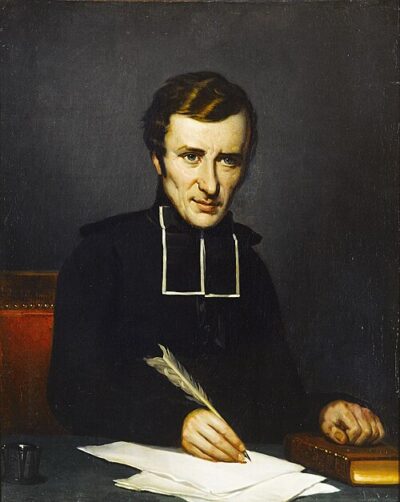
Félicité de La Mennais
Félicité de La Mennais was a French priest, philosopher and political theorist. Born June 19, 1782, in Saint-Malo. Died February 27, 1854, in Paris. Positions held include Member of the 1848 Constituent Assembly (1848–1849) and Deputy of the French Second Republic (1849–1851).
Facts
23 facts · 2 confirmed by two sources · 9 cited · 12 from one source
Where this comes from
Papalocal keeps its own record. It started from these sources; what each one said is kept here as it was copied, so a change on their side never changes this page by itself. Tap one to read its version.
What Wikidata says · copied November 16, 2026 · revision 2570021507
- Described as
- French priest, philosopher and political theorist (1782–1854)
- Other names
- Félicité de Lamennais, Robert Félicité de Lamennais, Félicité Robert de Lamenais, Felicite Robert de Lamennais, L' Abbé de Lamennais
- Born
- June 19, 1782 · 10 references
- Died
- February 27, 1854 · 9 references
- Born in
- Saint-Malo · 4 references
- Died in
- Paris · 4 references
- Buried in
- Père Lachaise Cemetery
- Citizen of
- France
- Occupation
- Catholic priest · 2 references; philosopher · 2 references; politician; translator; theologian · 1 reference; writer · 2 references
- Positions held
- Member of the 1848 Constituent Assembly (1848–1849) · 1 reference; Deputy of the French Second Republic (1849–1851) · 1 reference
- Field
- philosophy
- Father
- Pierre-Louis Robert de la Mennais
- Mother
- Gratienne-Jeanne Lorin
- Siblings
- Jean-Marie de La Mennais · 1 reference; Marie-Joseph de La Mennais; Louis-Marie Robert de La Mennais; Gratien Robert de La Mennais
- Religion
- Catholicism (–1836); pantheism
- Wikipedias with a page
- 48
Wikidata item Q334973 (wikidata.org/wiki/Q334973), public domain (CC0). Copied November 16, 2026.
What Wikipedia says · copied November 16, 2026 · revision 1376180188
Félicité Robert de La Mennais (or Lamennais, French: [lamnɛ]; 19 June 1782 – 27 February 1854) was a French Catholic priest, philosopher and political theorist. He was one of the most influential intellectuals of Restoration France. Lamennais is also considered the forerunner of both liberal Catholicism and Modernism.
His opinions on matters of religion and government changed dramatically over the course of his life. He initially held rationalistic views, but in part due to the influence of his elder brother, Jean-Marie, came to see religion as an antidote for the anarchy and tyranny unleashed by revolution. He derided Napoleon, in part because of the Organic Articles, in which France acting unilaterally amended the Concordat of 1801 between France and the papacy. Lamennais vocally assailed both Gallicanism and Caesaropapism, views that demanded a completely subservient relationship by the Church to the State, and he was for a time a staunch defender of the independence of the Church.
Lamennais was ordained a priest in 1817, the same year he published Essai sur l'indifférence en matière de religion. In 1830, he founded L'Ami de l'ordre (precursor of L'Avenir) with Montalembert and Lacordaire. His social ideas embraced an enlarged suffrage, separation of church and state, universal freedom of conscience, instruction, assembly, and the press. His radicalism distanced him from a number of his friends. In 1833, he broke with the Church and the following year published Paroles d'un croyant, which Pope Gregory XVI condemned for its philosophical theories.
He served as a deputy for Paris to the Constituent Assembly; his draft for a Constitution was rejected as too radical. He died in Paris in 1854.
- Born, in its opening lines
- June 19, 1782
- Died, in its opening lines
- February 27, 1854
From the Wikipedia article “Félicité de La Mennais” (en.wikipedia.org/wiki/Félicité_de_La_Mennais), by its contributors, under CC BY-SA 4.0 (creativecommons.org/licenses/by-sa/4.0/). Copied November 16, 2026; not changed.
Confirmed Two sources agree. Cited One source, and it names where it got it. One source One source, without a reference of its own. Sources disagree The sources disagree. We show the best-supported value and keep theirs below.
