
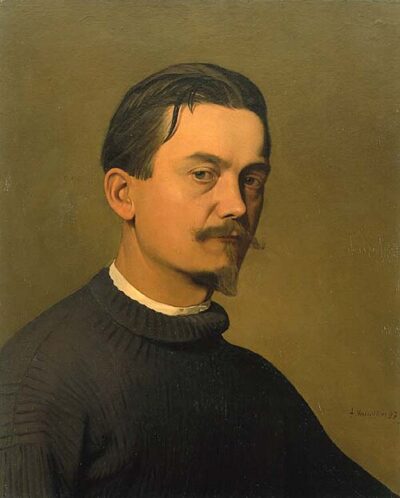
Félix Vallotton
Félix Vallotton was a Swiss painter and printmaker. Born December 28, 1865, in Lausanne. Died December 29, 1925, in Neuilly-sur-Seine. Known for Étude de fesses, The Abduction of Europa and Louis-Alfred Natanson. Educated at Académie Julian.
Facts
38 facts · 2 confirmed by two sources · 24 cited · 12 from one source
Where this comes from
Papalocal keeps its own record. It started from these sources; what each one said is kept here as it was copied, so a change on their side never changes this page by itself. Tap one to read its version.
What Wikidata says · copied November 16, 2026 · revision 2569158041
- Described as
- Swiss painter and printmaker (1865-1925)
- Other names
- F. Vallotton, Félix-Emile-Jean Vallotton, Félix Emile-Jean Vallotton, Félix-Édouard Vallotton, Félix Édouard Vallotton, Felix Vallotton, Vallotton
- Born
- December 28, 1865 · 13 references
- Died
- December 29, 1925 · 12 references
- Born in
- Lausanne · 4 references
- Died in
- Neuilly-sur-Seine · 4 references
- Buried in
- Montparnasse Cemetery
- Cause of death
- cancer
- Name at birth
- Félix Édouard Vallotton · 1 reference
- Citizen of
- Switzerland · 2 references; France (1900–) · 3 references
- Occupation
- painter · 5 references; sculptor · 2 references; art critic · 2 references; xylographer · 1 reference; illustrator · 2 references; novelist · 1 reference; printmaker · 2 references; writer · 2 references
- Education
- Académie Julian (1882–) · 1 reference
- Member of
- Les Nabis (1889–1903)
- Genre
- portrait · 2 references; landscape painting · 1 reference; genre painting · 1 reference; mythological painting · 1 reference; nude · 1 reference; self-portrait · 1 reference
- Known for
- Étude de fesses; The Abduction of Europa; Louis-Alfred Natanson; The White and the Black; The Sick Girl; Intimités
- Field
- painting · 1 reference; visual arts · 1 reference; literature · 1 reference; belletristic literature · 1 reference
- Spouse
- Gabrielle Bernheim (1899–) · 1 reference
- Siblings
- Paul Vallotton · 1 reference
- Religion
- reformed · 1 reference
- Wikipedias with a page
- 47
Wikidata item Q123740 (wikidata.org/wiki/Q123740), public domain (CC0). Copied November 16, 2026.
What Wikipedia says · copied November 16, 2026 · revision 1375150130
Félix Édouard Vallotton (French: [feliks edwaʁ valɔtɔ̃]; December 28, 1865 – December 29, 1925) was a Swiss and French painter and printmaker associated with the group of artists known as Les Nabis. He was an important figure in the development of the modern woodcut. He painted portraits, landscapes, nudes, still lifes, and other subjects in an unemotional, realistic style.
His earliest paintings were influenced by Holbein and Ingres. He developed a simpler style during his association with Les Nabis during the 1890s, and produced woodcuts which brought him international recognition. Characterized by broad masses of black and white with minimal detail, they include street scenes, bathers, portraits, and a series of ten interiors titled Intimités (Intimacies) that portray charged domestic encounters between men and women. He produced few prints after 1901, and concentrated instead on painting. His later paintings include highly finished portraits and nudes, and landscapes painted from memory.
He was also active as a writer. He published art criticism during the 1890s, and his novel La Vie meurtrière (The Murderous Life) was published posthumously.
- Born, in its opening lines
- December 28, 1865
- Died, in its opening lines
- December 29, 1925
From the Wikipedia article “Félix Vallotton” (en.wikipedia.org/wiki/Félix_Vallotton), by its contributors, under CC BY-SA 4.0 (creativecommons.org/licenses/by-sa/4.0/). Copied November 16, 2026; not changed.
Confirmed Two sources agree. Cited One source, and it names where it got it. One source One source, without a reference of its own. Sources disagree The sources disagree. We show the best-supported value and keep theirs below.
