
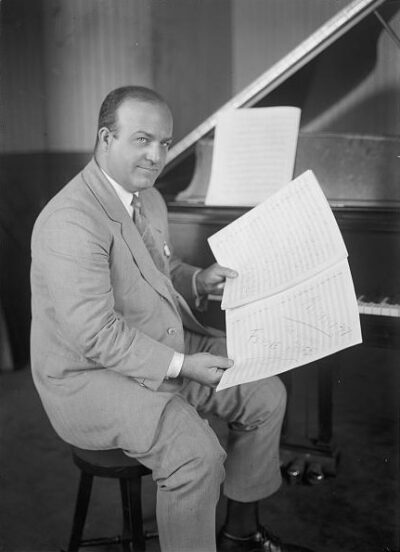
Ferde Grofé
Ferde Grofé was an American composer, arranger, pianist and instrumentalist. Born March 27, 1892, in New York City. Died April 3, 1972, in Santa Monica.
Facts
15 facts · 2 confirmed by two sources · 5 cited · 8 from one source
Where this comes from
Papalocal keeps its own record. It started from these sources; what each one said is kept here as it was copied, so a change on their side never changes this page by itself. Tap one to read its version.
What Wikidata says · copied November 16, 2026 · revision 2564266248
- Described as
- American composer, arranger, pianist and instrumentalist (1892–1972)
- Other names
- Ferde Grofe, Ferdinand Rudolph von Grofé
- Born
- March 27, 1892 · 9 references
- Died
- April 3, 1972 · 8 references
- Born in
- New York City · 2 references
- Died in
- Santa Monica · 2 references
- Buried in
- Inglewood Park Cemetery
- Name at birth
- Ferdinand Rudolph von Grofé
- Citizen of
- United States
- Occupation
- pianist · 1 reference; composer · 2 references; jazz musician; conductor · 1 reference; radio personality; film score composer
- Worked for
- Juilliard School
- Instrument
- piano
- Wikipedias with a page
- 21
Wikidata item Q375958 (wikidata.org/wiki/Q375958), public domain (CC0). Copied November 16, 2026.
What Wikipedia says · copied November 16, 2026 · revision 1384398263
Ferdinand Rudolph von Grofé (March 27, 1892 – April 3, 1972), known as Ferde Grofé () was an American composer, arranger, pianist, and instrumentalist. He is best known for his 1931 five-movement symphonic poem the Grand Canyon Suite, and for orchestrating George Gershwin's Rhapsody in Blue for its 1924 premiere.
During the 1920s and 1930s, he went by the name Ferdie Grofé.
- Born, in its opening lines
- March 27, 1892
- Died, in its opening lines
- April 3, 1972
From the Wikipedia article “Ferde Grofé” (en.wikipedia.org/wiki/Ferde_Grofé), by its contributors, under CC BY-SA 4.0 (creativecommons.org/licenses/by-sa/4.0/). Copied November 16, 2026; not changed.
Confirmed Two sources agree. Cited One source, and it names where it got it. One source One source, without a reference of its own. Sources disagree The sources disagree. We show the best-supported value and keep theirs below.
