
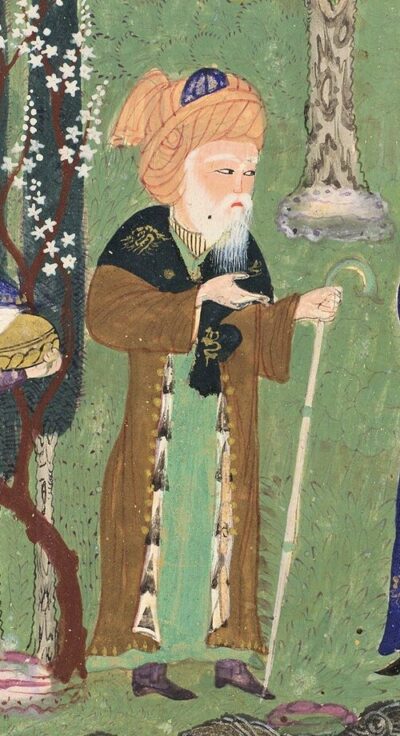
Ferdowsi
Ferdowsi was a Persian poet, author of Shahnameh. Born January 3, 940, in Tus. Died 1020, in Tus. Known for Shahnameh.
Facts
12 facts · 1 confirmed by two sources · 4 cited · 6 from one source · 1 where the sources disagree
What’s different
- Died: we show 1020 (Sources disagree). Wikipedia says 1025
Where this comes from
Papalocal keeps its own record. It started from these sources; what each one said is kept here as it was copied, so a change on their side never changes this page by itself. Tap one to read its version.
What Wikidata says · copied November 16, 2026 · revision 2567477808
- Described as
- Persian poet, author of Shahnameh (940–1020)
- Other names
- Ferdowsi Tousi, Abu’l-Qasim Firdawsi, Firdawsi, Firdusi, Firdosi, Firdausi, Ferdusi, Firdawsī, Abu'l Qasim Firdausi
- Born
- January 3, 940 · 1 reference
- Died
- 1020 · 3 references
- Born in
- Tus · 1 reference
- Died in
- Tus · 1 reference
- Buried in
- Tus
- Name at birth
- حَکیم اَبوالقاسِم فِردُوسی طوسی
- Citizen of
- Samanid Empire; Ghaznavid Empire
- Occupation
- poet · 1 reference; writer · 1 reference
- Known for
- Shahnameh
- Religion
- Shia Islam
- Wikipedias with a page
- 129
Wikidata item Q43459 (wikidata.org/wiki/Q43459), public domain (CC0). Copied November 16, 2026.
What Wikipedia says · copied November 16, 2026 · revision 1379759804
Abul-Qāsem Mansur bin Hasan Tosi (940–1025), better known by his pen name Ferdowsi, was a Persian poet who is notable for being the author of the Shahnameh ("Book of Kings"), which is one of the world's longest epic poems created by a single poet, and the greatest epic of the Persian-speaking countries. Ferdowsi is celebrated as one of the most influential figures of Persian literature and one of the greatest in the history of literature.
Born in 940, Ferdowsi came from a family of landed gentry. He spent the beginning of his life in the Samanid era and at the same time as the movement for independence and identity among Iranians. The Samanid kings, with the support of the Persian language, prepared a brilliant time for the cultivation of the Persian language and thought, and Ferdowsi is clearly indebted to his predecessors and all those who reached the pinnacle of the Persian language in the ninth and tenth centuries, and he was able to use that capital to express his speech so brilliantly. In a comprehensive look at Ferdowsi's knowledge and learnings, it can be said that he knew the Arabic language, but he did not dominate Arabic literature. In the "Baysunghur Shahnameh", Ferdowsi's name is associated with the title of "Hakim", which according to some refers to the wisdom of Khusrawani.
Researchers believe that Ferdowsi began composing the Shahnameh based on the Abu-Mansuri Shahnameh at the age of 30. The only poem that has been clarified about him is the Shahnameh itself. The Shahnameh is Ferdowsi's most famous poem and one of the greatest writings of ancient Persian literature. Ferdowsi completed the Shahnameh in 995, three years before Sultan Mahmud of Ghazni's accession to the throne. In 1010, Ferdowsi completed the second edition. Other poems have also been attributed to Ferdowsi, though most of these claims are considered baseless. The most famous of them is the masnaviof Yusuf and Zulaikha. Another poem that is known to be by Ferdowsi is a satire in condemnation of Mahmud.
In the Shahnameh, Ferdowsi links the culture of pre-Islamic Iran with the culture of post-Islamic Iran. It can be concluded from the Shahnameh that Ferdowsi was influenced by ancient Iranian religions such as Zoroastrianism, Zurvanism, Manichaeism, Mazdakism and Mithraism, although some researchers consider the source of these influences to be the themes of Ferdowsi's work, to which he was very loyal. Also, due to his peasant origins, he was familiar with the ancient culture and rituals of Iran, and later increased the scope of this knowledge, so that this knowledge established his poetic worldview. What Ferdowsi was dealing with was not only poetic, but also intellectual; he did not write fiction. Ferdowsi considers wisdom as the source and capital of all goodness. He believes that a person with wisdom recognizes good and evil from each other, and in this way, he reaches the happiness of this world and the salvation of that world. Ferdowsi carefully examined his motifs, most of which were from the Abu-Mansuri Shahnameh. He was able to gather an excerpt from the vast wealth of knowledge he had at his disposal to have a legacy carried by the Persians, Turks, and Indians.
- Born, in its opening lines
- 940
- Died, in its opening lines
- 1025
From the Wikipedia article “Ferdowsi” (en.wikipedia.org/wiki/Ferdowsi), by its contributors, under CC BY-SA 4.0 (creativecommons.org/licenses/by-sa/4.0/). Copied November 16, 2026; not changed.
Confirmed Two sources agree. Cited One source, and it names where it got it. One source One source, without a reference of its own. Sources disagree The sources disagree. We show the best-supported value and keep theirs below.
