
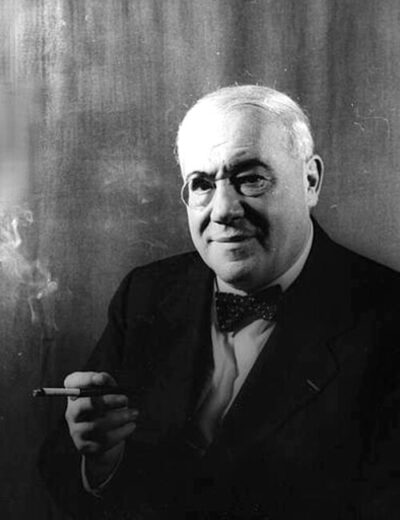
Ferenc Molnár
Ferenc Molnár was a Hungarian-born dramatist and novelist. Born January 12, 1878, in Budapest. Died April 1, 1952, in New York City. Known for The Paul Street Boys. Educated at University of Geneva. Awards include Officer of the Order of Franz Joseph.
Facts
26 facts · 2 confirmed by two sources · 10 cited · 14 from one source
Where this comes from
Papalocal keeps its own record. It started from these sources; what each one said is kept here as it was copied, so a change on their side never changes this page by itself. Tap one to read its version.
What Wikidata says · copied November 16, 2026 · revision 2570103768
- Described as
- Hungarian-born dramatist and novelist (1878-1952)
- Other names
- Ferenc Molnar
- Born
- January 12, 1878 · 16 references
- Died
- April 1, 1952 · 6 references
- Born in
- Budapest · 5 references
- Died in
- New York City · 4 references
- Buried in
- Linden Hill Jewish Cemetery · 1 reference
- Cause of death
- cancer
- Name at birth
- Neumann Ferenc
- Citizen of
- Hungary
- Occupation
- writer · 3 references; journalist; playwright · 1 reference; screenwriter; children's writer
- Worked for
- Nyugat
- Education
- University of Geneva (1897)
- Known for
- The Paul Street Boys
- Awards
- Officer of the Order of Franz Joseph
- Field
- literature · 1 reference; drama · 1 reference; film screenwriting · 1 reference; journalism · 1 reference
- Spouse
- Sári Fedák (1922–1924) · 1 reference; Margit Vészi (1906–1910) · 2 references; Lili Darvas (1926–1952) · 1 reference
- Children
- Márta Sárközy
- Father
- Mór Neumann
- Wikipedias with a page
- 49
Wikidata item Q296809 (wikidata.org/wiki/Q296809), public domain (CC0). Copied November 16, 2026.
What Wikipedia says · copied November 16, 2026 · revision 1383148069
Ferenc Molnár (US: FERR-ents MOHL-nar, -ənts -, - MAWL-, Hungarian: [ˈfɛrɛnt͡s ˈmolnaːr]; born Ferenc Neumann; January 12, 1878 – April 1, 1952), often anglicized as Franz Molnar, was a Hungarian-born author, stage director, dramatist, and poet. He is widely regarded as Hungary's most celebrated and controversial playwright.
His primary aim through his writing was to entertain by transforming his personal experiences into literary works of art. While he never connected to any one literary movement, he did use the precepts of naturalism, neo-romanticism, expressionism, and Freudian psychoanalytic theories, so long as they suited his desires. According to Clara Györgyey, “By fusing the realistic narrative and stage tradition of Hungary with Western influences into a cosmopolitan amalgam, Molnár emerged as a versatile artist whose style was uniquely his own."
As a novelist, Molnár is perhaps remembered best for The Paul Street Boys, the story of two rival gangs of youths in Budapest. It has been translated into 42 languages and adapted for the stage and film. It has been considered a masterpiece by many.
However, it was as a playwright that he made his most significant contribution and how he is best known internationally. For Györgyey, "In his graceful, whimsical, sophisticated drawing-room comedies, he provided a felicitous synthesis of naturalism and fantasy, realism and romanticism, cynicism, and sentimentality, the profane and the sublime." Of his many plays, The Devil, Liliom, The Swan, The Guardsman, and The Play's the Thing endure as classics. His influences included luminaries such as Oscar Wilde, George Bernard Shaw, and Gerhart Hauptmann.
Molnár's plays continue to be performed world-wide. His national and international fame has inspired many Hungarian playwrights, including Elemér Boross, László Fodor, Lajos Bíró, László Bús-Fekete, Ernő Vajda, Attila Orbók, and Imre Földes, among others.
He immigrated to the United States to escape the persecution of Hungarian Jews during World War II and later adopted American citizenship. He died in New York City.
- Born, in its opening lines
- January 12, 1878
- Died, in its opening lines
- April 1, 1952
From the Wikipedia article “Ferenc Molnár” (en.wikipedia.org/wiki/Ferenc_Molnár), by its contributors, under CC BY-SA 4.0 (creativecommons.org/licenses/by-sa/4.0/). Copied November 16, 2026; not changed.
Confirmed Two sources agree. Cited One source, and it names where it got it. One source One source, without a reference of its own. Sources disagree The sources disagree. We show the best-supported value and keep theirs below.
