
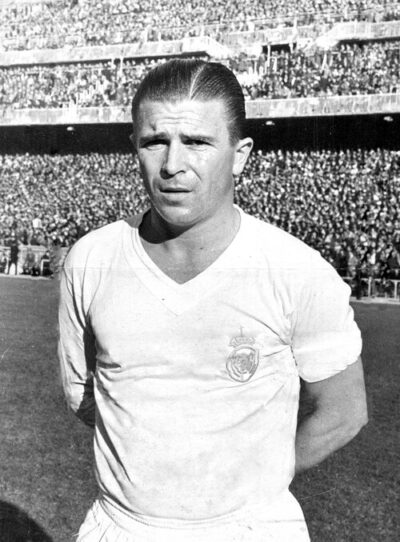
Ferenc Puskás
Ferenc Puskás was a Hungarian association football player. Born April 1, 1927, in Budapest. Died November 17, 2006, in Budapest. Teams include Real Madrid Club de Fútbol (1958–1966), Kispest-Honvéd FC (1943–1956) and Hungary men's national football team (1945–1956). Awards include honorary citizen of Budapest and Silver Olympic Order.
Facts
22 facts · 2 confirmed by two sources · 7 cited · 13 from one source
Where this comes from
Papalocal keeps its own record. It started from these sources; what each one said is kept here as it was copied, so a change on their side never changes this page by itself. Tap one to read its version.
What Wikidata says · copied November 16, 2026 · revision 2563646062
- Described as
- Hungarian association football player (1927–2006)
- Other names
- Ferenc Purczeld Biró, Ferenc Puskas, Ferenc Purczeld Biro, Ferenc Purczeld, Puskas, Ferenc Purczeld Bíró
- Born
- April 1, 1927 · 4 references
- Died
- November 17, 2006 · 9 references
- Born in
- Budapest · 2 references
- Died in
- Budapest · 1 reference
- Buried in
- St. Stephen's Basilica · 1 reference
- Cause of death
- pneumonia
- Name at birth
- Ferenc Purczeld Bíró
- Citizen of
- Hungary; Spain
- Occupation
- association football player · 1 reference; association football coach · 1 reference
- Teams
- Real Madrid Club de Fútbol (1958–1966); Kispest-Honvéd FC (1943–1956); Hungary men's national football team (1945–1956); Spain men's national football team (1961–1962)
- Sport
- association football · 1 reference
- Awards
- honorary citizen of Budapest (2001); Silver Olympic Order (1997)
- Spouse
- Erzsébet Hunyadvári (1950–2006)
- Nickname
- Öcsi · 1 reference
- Height
- 1.72 m (5 ft 8 in)
- Website
- http://www.puskas.com/en/home.html
- Wikipedias with a page
- 93
Wikidata item Q482931 (wikidata.org/wiki/Q482931), public domain (CC0). Copied November 16, 2026.
What Wikipedia says · copied November 16, 2026 · revision 1383036742
Ferenc Puskás (né Purczeld; 1 April 1927 – 17 November 2006) was a Hungarian professional footballer and manager. Nicknamed the "Galloping Major", Puskás is widely regarded as one of the greatest players of all time, the greatest Hungarian footballer of all time, and the sport's first international superstar. A forward and an attacking midfielder, he scored 84 goals in 85 international matches for Hungary and later played four international matches for Spain as well. He is the European all-time top assist provider in international football (53). He became an Olympic champion in 1952 and led his nation to the final of the 1954 World Cup. He won three European Cups (1959, 1960, 1966), ten national championships (five Hungarian and five Spanish Primera División) and eight top individual scoring honors. In 1995, he was recognized as the greatest top division scorer of the 20th century by the IFFHS. Scoring 802 goals in 792 official games during his career, he is the seventh top goal scorer of all time by the RSSSF.
The son of former footballer Ferenc Puskás Sr., Puskás started his career in Hungary playing for Kispest and Budapest Honvéd. He was the top scorer in the Hungarian League on four occasions, and in 1948, he was the top goal scorer in Europe. During the 1950s, he was both a prominent member and captain of the Hungary national team, known as the Mighty Magyars. After the Hungarian Revolution, Puskás served a two year ban from UEFA. Despite failing to sign for Ethnikos Piraeus in 1957 under pressure from rival clubs, in 1958, he emigrated to Spain where he successfully signed for Real Madrid at the age of 31. While playing with the club, Puskás won four Pichichi Trophies, which is awarded to the top goalscorer of La Liga each season, and scored seven goals in two European Cup finals, winning the competition three times with the club and claiming five consecutive La Liga titles. He scored 619 goals in 618 matches in the Hungarian and Spanish leagues and National Cups.
After retiring as a player, he became a coach. The highlight of his managerial career came in 1971 when he guided Panathinaikos to the European Cup final, where they lost 2–0 to Ajax. He also led the club to the championship in 1972, becoming an icon in the country. Afterward he'd have spells at various countries and clubs, including Spain, Paraguay and the Saudi Arabia national team, with varying success. He returned again to Greece to manage an exceptionally strong AEK Athens team for the 1978–79 season. In 1993, he returned to Hungary and took temporary charge of the Hungary national team. In 1998, he became one of the first ever FIFA/SOS Charity ambassadors. In 2002, the Népstadion in Budapest was renamed the Puskás Ferenc Stadion in his honor. He was also declared the best Hungarian player of the last 50 years by the Hungarian Football Federation in the UEFA Jubilee Awards in November 2003. In October 2009, FIFA announced the introduction of the FIFA Puskás Award, awarded to the player who has scored the "most beautiful goal" over the past calendar year. In 2004, he was listed by Pelé in the FIFA 100, which featured his choices for the 100 best living footballers at the time of its release.
- Born, in its opening lines
- April 1, 1927
- Died, in its opening lines
- November 17, 2006
From the Wikipedia article “Ferenc Puskás” (en.wikipedia.org/wiki/Ferenc_Puskás), by its contributors, under CC BY-SA 4.0 (creativecommons.org/licenses/by-sa/4.0/). Copied November 16, 2026; not changed.
Confirmed Two sources agree. Cited One source, and it names where it got it. One source One source, without a reference of its own. Sources disagree The sources disagree. We show the best-supported value and keep theirs below.
