
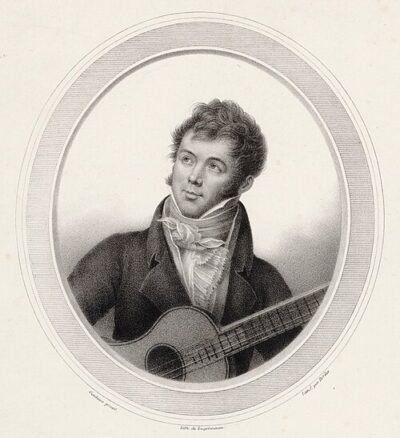
Fernando Sor
Fernando Sor was a Spanish classical guitarist and composer. Born February 13, 1778, in Barcelona. Died July 10, 1839, in Paris.
Facts
23 facts · 1 confirmed by two sources · 8 cited · 13 from one source · 1 where the sources disagree
What’s different
- Born: we show February 13, 1778 (Sources disagree). Wikipedia says February 14, 1778
Where this comes from
Papalocal keeps its own record. It started from these sources; what each one said is kept here as it was copied, so a change on their side never changes this page by itself. Tap one to read its version.
What Wikidata says · copied November 16, 2026 · revision 2557879450
- Described as
- Spanish classical guitarist and composer (1778-1839)
- Other names
- Ferran Sor, Ferdinando Sor, Ferdinand Sor, José Fernando Macario Sors, Sor
- Born
- February 13, 1778 · 5 references
- Died
- July 10, 1839 · 8 references
- Born in
- Barcelona · 2 references
- Died in
- Paris · 2 references
- Buried in
- Montmartre Cemetery · 1 reference
- Cause of death
- esophageal cancer
- Citizen of
- Spain
- Occupation
- guitarist · 1 reference; composer · 2 references; classical guitarist; performing artist
- Genre
- classical music · 1 reference
- Instrument
- violin; classical guitar; piano
- Field
- opera · 1 reference; instrumental music · 1 reference; classical guitar repertoire; étude; music education; Classical period
- Spouse
- Félicité Hullin-Sor
- Website
- http://www.sorfernando.com/ · 1 reference
- Wikipedias with a page
- 36
Wikidata item Q254110 (wikidata.org/wiki/Q254110), public domain (CC0). Copied November 16, 2026.
What Wikipedia says · copied November 16, 2026 · revision 1370691840
Fernando Sor (baptised 14 February 1778 – 10 July 1839) was a Spanish classical guitarist and composer of the late Classical era and early Romantic era. Best known for writing solo classical guitar music, he also composed an opera (at the age of 19), three symphonies, guitar duos, piano music, songs, a Mass, and at least two successful ballets: Cinderella, which received over one hundred performances, and Hercule et Omphale.
Partly because Sor was himself such a classical guitar virtuoso—contemporaries considered him to be the best in the world—he made a point of writing didactic music for players of that instrument of all levels. His Twelve Studies Op. 6, the Twelve Studies Op. 29, the (24) Progressive Lessons Op. 31, and the (24) Very Easy Exercises Op. 35 have been widely played for two hundred years and are regularly reprinted. On the other hand, Sor's concert pieces, like the popular Introduction and Variations on Mozart's "Das klinget so herrlich" Op. 9, belong to the advanced guitar performance repertoire.
Unlike modern classical guitar players, Sor used the smaller, slimmer "Romantic" guitars predating today's familiar guitar standards set by Torres. He used the ring finger of his plucking hand "rarely" and "only for harmony (never for melody)." He eschewed the use of nails on that hand.
- Born, in its opening lines
- February 14, 1778
- Died, in its opening lines
- July 10, 1839
From the Wikipedia article “Fernando Sor” (en.wikipedia.org/wiki/Fernando_Sor), by its contributors, under CC BY-SA 4.0 (creativecommons.org/licenses/by-sa/4.0/). Copied November 16, 2026; not changed.
Confirmed Two sources agree. Cited One source, and it names where it got it. One source One source, without a reference of its own. Sources disagree The sources disagree. We show the best-supported value and keep theirs below.
