
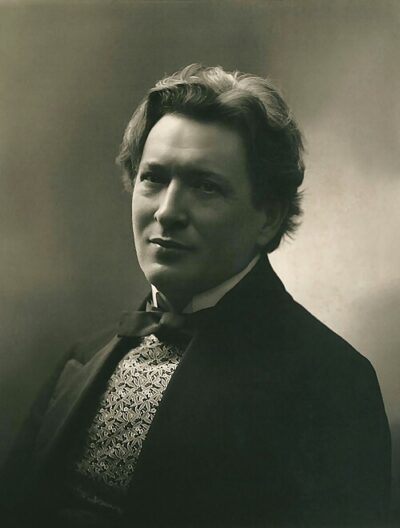
Ferruccio Busoni
Ferruccio Busoni was an Italian composer, pianist, and conductor. Born April 1, 1866, in Empoli. Died July 27, 1924, in Berlin. Known for Turandot. Educated at University of Music and Theatre Leipzig. Awards include Honorary Member of the International Society for Contemporary Music.
Facts
32 facts · 2 confirmed by two sources · 16 cited · 14 from one source
Where this comes from
Papalocal keeps its own record. It started from these sources; what each one said is kept here as it was copied, so a change on their side never changes this page by itself. Tap one to read its version.
What Wikidata says · copied November 16, 2026 · revision 2568732167
- Described as
- Italian composer, pianist, and conductor (1866–1924)
- Other names
- Busoni, Ferruccio Dante Michelangiolo Benvenuto Busoni, Ferruccio Dante Michelangelo Benvenuto Busoni
- Born
- April 1, 1866 · 12 references
- Died
- July 27, 1924 · 12 references
- Born in
- Empoli · 2 references
- Died in
- Berlin · 4 references
- Buried in
- III. Städtischer Friedhof Stubenrauchstraße · 1 reference
- Cause of death
- kidney disease
- Name at birth
- Ferruccio Dante Michelangiolo Benvenuto Busoni · 1 reference
- Citizen of
- Kingdom of Italy
- Occupation
- composer · 2 references; pianist · 2 references; conductor · 1 reference; musicologist; music educator; music theorist · 1 reference; recording artist; music arranger · 1 reference
- Worked for
- University of Music and Performing Arts Vienna
- Education
- University of Music and Theatre Leipzig
- Member of
- Prussian Academy of Arts
- Genre
- opera · 1 reference
- Instrument
- piano
- Known for
- Turandot
- Awards
- Honorary Member of the International Society for Contemporary Music · 1 reference
- Spouse
- Gerda Busoni · 1 reference
- Children
- Rafaello Busoni · 1 reference; Benvenuto Busoni · 1 reference
- Father
- Ferdinando Busoni · 1 reference
- Mother
- Anna Weiss-Busoni · 1 reference
- Religion
- Catholicism · 1 reference
- Lived in
- Berlin; Bologna; Zurich
- Wikipedias with a page
- 55
Wikidata item Q219551 (wikidata.org/wiki/Q219551), public domain (CC0). Copied November 16, 2026.
What Wikipedia says · copied November 16, 2026 · revision 1384950084
Ferruccio Dante Michelangiolo Benvenuto Busoni (1 April 1866 – 27 July 1924) was an Italian composer, pianist, conductor, editor, writer, and teacher. His international career and reputation led him to work closely with many of the leading musicians, artists and literary figures of his time, and he was a sought-after keyboard instructor and a teacher of composition.
From an early age, Busoni was an outstanding, if sometimes controversial, pianist. He studied at the Vienna Conservatory and then with Wilhelm Mayer and Carl Reinecke. After brief periods teaching in Helsinki, Boston, and Moscow, he devoted himself to composing, teaching, and touring as a virtuoso pianist in Europe and the United States. His writings on music were influential, and covered not only aesthetics but considerations of microtones and other innovative topics. He was based in Berlin from 1894 but spent much of World War I in Switzerland.
He began composing in his early years in a late romantic style, but after 1907, when he published his Sketch of a New Esthetic of Music, he developed a more individual style, often with elements of atonality. His visits to America led to interest in North American indigenous tribal melodies which were reflected in some of his works. His compositions include works for piano, among them a monumental Piano Concerto, and transcriptions of the works of others, notably Johann Sebastian Bach (published as the Bach-Busoni Editions). He also wrote chamber music, vocal and orchestral works, and operas—one of which, Doktor Faust, he left unfinished when he died, in Berlin, at the age of 58.
- Born, in its opening lines
- April 1, 1866
- Died, in its opening lines
- July 27, 1924
From the Wikipedia article “Ferruccio Busoni” (en.wikipedia.org/wiki/Ferruccio_Busoni), by its contributors, under CC BY-SA 4.0 (creativecommons.org/licenses/by-sa/4.0/). Copied November 16, 2026; not changed.
Confirmed Two sources agree. Cited One source, and it names where it got it. One source One source, without a reference of its own. Sources disagree The sources disagree. We show the best-supported value and keep theirs below.
