
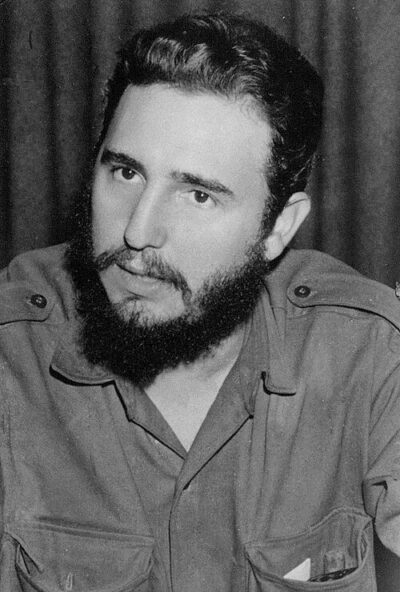
Fidel Castro
Fidel Castro was a Cuban politician, author and revolutionary. Born August 13, 1926, in Birán. Died November 25, 2016, in Havana. Positions held include President of Cuba (1976–2008), First Secretary of the Communist Party of Cuba (1961–2011) and Prime Minister of Cuba (1959–2008). Educated at University of Havana and Belen Jesuit Preparatory School. Awards include Hero of the Soviet Union, Order of Lenin (3 times) and Jubilee Medal "Thirty Years of Victory in the Great Patriotic War 1941–1945".
Facts
62 facts · 2 confirmed by two sources · 21 cited · 39 from one source
Where this comes from
Papalocal keeps its own record. It started from these sources; what each one said is kept here as it was copied, so a change on their side never changes this page by itself. Tap one to read its version.
What Wikidata says · copied November 16, 2026 · revision 2568634249
- Described as
- Cuban politician, author and revolutionary (1926–2016)
- Other names
- Fidel Alejandro Castro Ruz
- Born
- August 13, 1926 · 12 references
- Died
- November 25, 2016 · 12 references
- Born in
- Birán · 1 reference
- Died in
- Havana · 1 reference
- Buried in
- Santa Ifigenia Cemetery
- Name at birth
- Fidel Alejandro Castro Ruz · 1 reference
- Citizen of
- Cuba
- Occupation
- politician · 1 reference; lawyer; partisan; journalist · 1 reference; revolutionary · 2 references; statesperson; film actor · 1 reference; jurist · 1 reference
- Positions held
- President of Cuba (1976–2008); First Secretary of the Communist Party of Cuba (1961–2011); Prime Minister of Cuba (1959–2008); Secretary General of the Non-Aligned Movement (2 times) (1979–2008)
- Political party
- Communist Party of Cuba (1965–); Party of the Cuban People – Orthodox (–1951); 26th of July Movement (1955–1965); Integrated Revolutionary Organizations (1961–1962)
- Education
- University of Havana (1945–1950); Belen Jesuit Preparatory School (1945)
- Member of
- 26th of July Movement
- Awards
- Hero of the Soviet Union (1963) · 1 reference; Order of Lenin (3 times) (1963, 1972, 1986) · 1 reference; Jubilee Medal "Thirty Years of Victory in the Great Patriotic War 1941–1945" (1975) · 1 reference; Order of the October Revolution (1976); Collar of the Order of the White Lion (1972) · 1 reference; Star of the Socialist Republic of Romania (1972) · 1 reference; Order of Georgi Dimitrov (1972) · 1 reference; Grand Cross of the Order of Polonia Restituta (1973) · 1 reference; Order of Jamaica (1977); Order of Merit (1977) · 1 reference; Order of Karl Marx (1986) · 1 reference; Grand Cross of the Order of the Aztec Eagle (1988); Order of Klement Gottwald (1986) · 1 reference; Order of Merit of Duarte, Sanchez and Mella (1998) · 1 reference; Grand Collar of the Order of Good Hope (1998) · 1 reference
- Field
- politics · 1 reference
- Spouse
- Mirta Díaz-Balart (1948–1955); Dalia Soto del Valle (1980–2016)
- Children
- Alina Fernández · 1 reference; Fidel Ángel Castro Díaz-Balart · 1 reference; Jorge Ángel Castro; Fransiska Pupo; Antonio Castro Soto del Valle; Alex Castro -Soto; Alexis Castro-Soto; Alejandro Castro-Soto; Ángel Castro-Soto
- Father
- Ángel Castro y Arguíz
- Mother
- Lina Ruz González
- Siblings
- Juanita Castro · 1 reference; Ramón Castro Ruz; Raúl Castro · 1 reference; Lidia Castro Argota; Emma Castro
- Religion
- agnosticism
- Military rank
- commandant
- Wikipedias with a page
- 208
Wikidata item Q11256 (wikidata.org/wiki/Q11256), public domain (CC0). Copied November 16, 2026.
What Wikipedia says · copied November 16, 2026 · revision 1384309406
Fidel Alejandro Castro Ruz (13 August 1926 – 25 November 2016) was a Cuban revolutionary and politician who was the leader of Cuba from 1959 to 2011. He served as prime minister from 1959 to 1976, president from 1976 to 2008, and first secretary of the Communist Party of Cuba from 1965 until 2011. Ideologically a Marxist–Leninist and Cuban nationalist, under his administration Cuba became a one-party communist state; industry and business were nationalized, and socialist reforms were implemented throughout society.
Born in Birán, the son of a wealthy Spanish farmer, Castro adopted leftist and anti-imperialist ideas while studying law at the University of Havana. After participating in rebellions against right-wing governments in the Dominican Republic and Colombia, he planned the overthrow of Cuban president Fulgencio Batista, launching a failed attack on the Moncada Barracks in 1953. After a year's imprisonment, Castro travelled to Mexico where he formed a revolutionary group, the 26th of July Movement, with his brother, Raúl Castro, and Ernesto "Che" Guevara. Returning to Cuba, Castro took a key role in the Cuban Revolution by leading the movement in a guerrilla war against Batista's forces from the Sierra Maestra. After Batista's overthrow in 1959, Castro assumed military and political power as Cuba's prime minister. The United States came to oppose Castro's government and unsuccessfully attempted to remove him by assassination, economic embargo, and counter-revolution, including the Bay of Pigs Invasion of 1961. Countering these threats, Castro aligned with the Soviet Union and allowed the Soviets to place nuclear weapons in Cuba, resulting in the Cuban Missile Crisis—a defining incident of the Cold War—in 1962.
Adopting a Marxist–Leninist model of development, Castro converted Cuba into a one-party, socialist state under Communist Party rule, the first in the Western Hemisphere. Policies introducing central economic planning and expanding healthcare and education were accompanied by state control of the press and the suppression of internal dissent. Abroad, Castro supported anti-imperialist revolutionary groups, backing the establishment of Marxist governments in Chile, Nicaragua, and Grenada, as well as sending troops to aid allies in the Yom Kippur, Ogaden, and Angolan Civil wars. These actions, coupled with Castro's leadership of the Non-Aligned Movement from 1979 to 1983 and Cuban medical internationalism, increased Cuba's profile on the world stage. Following the dissolution of the Soviet Union in 1991, Castro led Cuba through the economic downturn of the "Special Period", embracing environmentalist and anti-globalization ideas. In the 2000s, Castro forged alliances in the Latin American "Pink Tide"—namely with Hugo Chávez's Venezuela—and formed the Bolivarian Alliance for the Americas. In 2006, Castro transferred his responsibilities to Vice President Raúl Castro, who was elected to the presidency by the National Assembly in 2008. Castro died at the age of 90 from natural causes in November 2016.
Castro was the longest-serving non-royal head of state in the 20th and 21st centuries and polarized world opinion about his rule. His supporters view him as a champion of socialism and anti-imperialism whose revolutionary government advanced economic and social justice while securing Cuba's independence from American hegemony. His critics view him as a dictator whose administration oversaw human rights abuses, the exodus of many Cubans, and the impoverishment of the country's economy.
- Born, in its opening lines
- August 13, 1926
- Died, in its opening lines
- November 25, 2016
From the Wikipedia article “Fidel Castro” (en.wikipedia.org/wiki/Fidel_Castro), by its contributors, under CC BY-SA 4.0 (creativecommons.org/licenses/by-sa/4.0/). Copied November 16, 2026; not changed.
Confirmed Two sources agree. Cited One source, and it names where it got it. One source One source, without a reference of its own. Sources disagree The sources disagree. We show the best-supported value and keep theirs below.
