
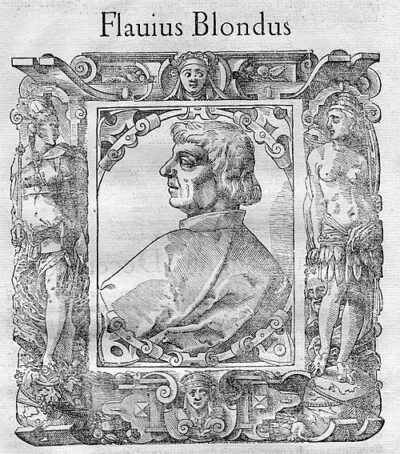
Flavio Biondo was a historian from Italy. Born 1392, in Forlì. Died June 4, 1463, in Rome.
Facts
10 facts · 2 confirmed by two sources · 4 cited · 4 from one source
What’s different
- Born: we show 1392 (Confirmed). Wikidata also lists 1388
Where this comes from
Papalocal keeps its own record. It started from these sources; what each one said is kept here as it was copied, so a change on their side never changes this page by itself. Tap one to read its version.
What Wikidata says · copied November 16, 2026 · revision 2570027532
- Described as
- historian from Italy
- Other names
- Biondo Flavio, Blondus Flavius
- Born
- 1388 · 1 reference; 1392 · 1 reference; 1392 · 1 reference
- Died
- June 4, 1463 · 3 references
- Born in
- Forlì · 1 reference
- Died in
- Rome · 1 reference
- Occupation
- historian · 1 reference; archaeologist; geographer · 1 reference; Renaissance humanist · 1 reference
- Field
- history
- Children
- Gabriele Biondo
- Wikipedias with a page
- 33
Wikidata item Q434834 (wikidata.org/wiki/Q434834), public domain (CC0). Copied November 16, 2026.
What Wikipedia says · copied November 16, 2026 · revision 1385563521
Flavio Biondo (Latin Flavius Blondus) (1392 – June 4, 1463) was an Italian Renaissance humanist historian. He was one of the first historians to use a three-period division of history (Ancient, Medieval, Modern) and is known as one of the first archaeologists.
Born in the capital city of Forlì, in the Romagna region, Biondo was well schooled from an early age, studying under Ballistario of Cremona. During a brief stay in Milan, he discovered and transcribed the unique manuscript of Cicero's dialogue Brutus. He moved to Rome in 1433 where he began work on his writing career; he was appointed secretary to the Cancelleria under Pope Eugene IV in 1444 and accompanied Eugene in his exile in Ferrara and Florence. After his patron's death, Biondo was employed by his papal successors, Nicholas V, Callixtus III and the humanist Pius II.
- Born, in its opening lines
- 1392
- Died, in its opening lines
- June 4, 1463
From the Wikipedia article “Flavio Biondo” (en.wikipedia.org/wiki/Flavio_Biondo), by its contributors, under CC BY-SA 4.0 (creativecommons.org/licenses/by-sa/4.0/). Copied November 16, 2026; not changed.
Confirmed Two sources agree. Cited One source, and it names where it got it. One source One source, without a reference of its own. Sources disagree The sources disagree. We show the best-supported value and keep theirs below.
