
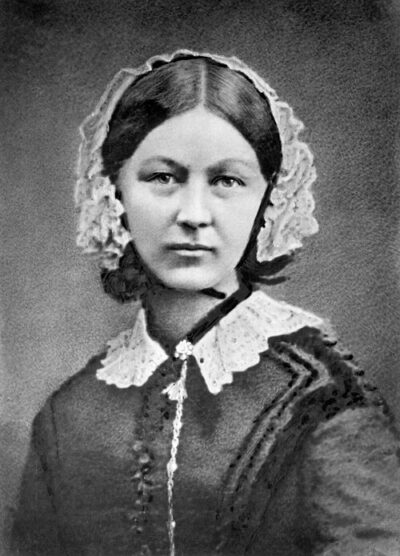
Florence Nightingale
Florence Nightingale was an English social reformer, statistician, and founder of modern nursing. Born May 12, 1820, in Florence. Died August 13, 1910, in London. Awards include Order of Merit, Fellow of the Royal Statistical Society and Decoration of the Royal Red Cross.
Facts
22 facts · 2 confirmed by two sources · 12 cited · 8 from one source
Where this comes from
Papalocal keeps its own record. It started from these sources; what each one said is kept here as it was copied, so a change on their side never changes this page by itself. Tap one to read its version.
What Wikidata says · copied November 16, 2026 · revision 2564105242
- Described as
- English social reformer, statistician, and founder of modern nursing (1820–1910)
- Other names
- Lady with the Lamp, Nightingale Florence, Miss Smith, Angel of Crimea
- Born
- May 12, 1820 · 17 references
- Died
- August 13, 1910 · 17 references
- Born in
- Florence · 3 references
- Died in
- London · 2 references
- Buried in
- Church of St Margaret · 2 references
- Citizen of
- United Kingdom of Great Britain and Ireland
- Occupation
- nurse · 3 references; statistician · 1 reference; writer; politician; teacher · 1 reference; sociologist
- Member of
- Royal Statistical Society
- Awards
- Order of Merit (1907) · 1 reference; Fellow of the Royal Statistical Society (1858) · 1 reference; Decoration of the Royal Red Cross (1883) · 1 reference
- Field
- health care
- Father
- William Nightingale · 2 references
- Mother
- Frances Smith · 3 references
- Siblings
- Frances Parthenope Verney · 2 references
- Religion
- Anglicanism
- Lived in
- United Kingdom of Great Britain and Ireland
- Wikipedias with a page
- 153
Wikidata item Q37103 (wikidata.org/wiki/Q37103), public domain (CC0). Copied November 16, 2026.
What Wikipedia says · copied November 16, 2026 · revision 1385768270
Florence Nightingale () (12 May 1820 – 13 August 1910) was an English social reformer, statistician and the founder of modern nursing. Nightingale came to prominence while serving as a manager and trainer of nurses during the Crimean War, in which she organised care for wounded soldiers at Constantinople. She significantly reduced death rates by improving hygiene and living standards. Nightingale gave nursing a favourable reputation and became an icon of Victorian culture, especially in the persona of "The Lady with the Lamp" making ward rounds for wounded soldiers at night.
Recent commentators have asserted that Nightingale's Crimean War achievements were exaggerated by the media at the time, but critics agree on the importance of her later work in professionalising nursing roles for women. In 1860, she laid the foundation of professional nursing with the establishment of her nursing school at St Thomas' Hospital in London. It was the first secular nursing school in the world and is now part of King's College London. In recognition of her pioneering work in nursing, the Nightingale Pledge taken by new nurses, and the Florence Nightingale Medal, the highest international distinction a nurse can achieve, were named in her honour, and the annual International Nurses Day is celebrated on her birthday. Her social reforms included improving healthcare for all sections of British society, advocating better hunger relief in India, helping to abolish prostitution laws that were harsh for women, and expanding the acceptable forms of female participation in the workforce.
Nightingale was an innovator in statistics; she represented her analysis in graphical forms to ease drawing conclusions and actionables from data. She is famous for usage of the polar area diagram, also called the Nightingale rose diagram, which is equivalent to a modern circular histogram or pie chart. This diagram is still regularly used in data visualisation.
Nightingale was a prodigious and versatile writer. In her lifetime, much of her published work was concerned with spreading medical knowledge. Some of her tracts were written in simple English so that they could easily be understood by those with poor literary skills. Much of her writing, including her extensive work on religion and mysticism, has only been published posthumously.
- Born, in its opening lines
- May 12, 1820
- Died, in its opening lines
- August 13, 1910
From the Wikipedia article “Florence Nightingale” (en.wikipedia.org/wiki/Florence_Nightingale), by its contributors, under CC BY-SA 4.0 (creativecommons.org/licenses/by-sa/4.0/). Copied November 16, 2026; not changed.
Confirmed Two sources agree. Cited One source, and it names where it got it. One source One source, without a reference of its own. Sources disagree The sources disagree. We show the best-supported value and keep theirs below.
