
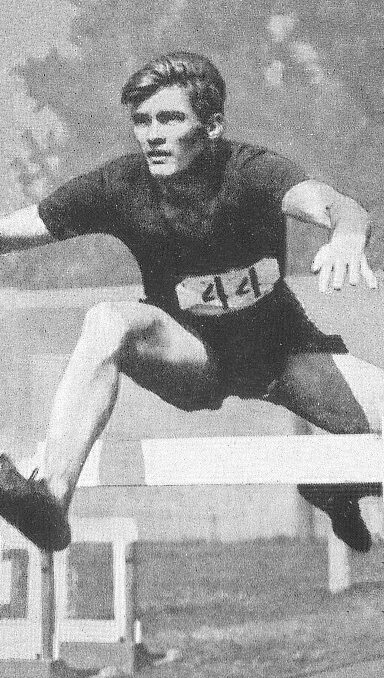
Forrest Towns
Forrest Towns was an American hurdler. Born February 6, 1914, in Fitzgerald. Died April 9, 1991, in Athens. Educated at University of Georgia. Awards include Bislett medal.
Facts
10 facts · 2 confirmed by two sources · 1 cited · 7 from one source
Where this comes from
Papalocal keeps its own record. It started from these sources; what each one said is kept here as it was copied, so a change on their side never changes this page by itself. Tap one to read its version.
What Wikidata says · copied November 16, 2026 · revision 2564936532
- Described as
- American hurdler (1914–1991)
- Born
- February 6, 1914
- Died
- April 9, 1991
- Born in
- Fitzgerald
- Died in
- Athens
- Citizen of
- United States
- Occupation
- athletics competitor
- Education
- University of Georgia · 2 references
- Sport
- athletics
- Awards
- Bislett medal (1990)
- Height
- 1.88 m (6 ft 2 in)
- Wikipedias with a page
- 23
Wikidata item Q706262 (wikidata.org/wiki/Q706262), public domain (CC0). Copied November 16, 2026.
What Wikipedia says · copied November 16, 2026 · revision 1385158677
Forrest Grady "Spec" Towns (February 6, 1914 – April 9, 1991) was an American track and field athlete and coach. He was the 1936 Olympic champion in the 110 m hurdles and broke the world record in that event three times.
Born in Fitzgerald, Georgia, Towns grew up in Augusta, Georgia, where he played football in high school at Richmond Academy. In 1933, he earned a football scholarship to the University of Georgia (UGA) after a sports journalist had seen him high jumping in his backyard.
Rather than high jumping, Towns specialized in the high hurdles. While competing on the UGA Track Team from 1933 to 1937, Towns won five Southeastern Conference individual titles and two NCAA titles. He won both the NCAA and AAU titles in the 120 y hurdles event in 1935. It was the beginning of a 60 race winning streak, lasting until 1937.
In 1936, Towns was named to the American Olympic team, becoming the first Georgian to achieve this. During the Olympics in Berlin, Germany, Towns became the world record holder with 14.1, and he won the Olympic gold in 14.2. Also, he became the first Georgian to earn Olympic Gold. Shortly after the Games, he became the first hurdler under 14 seconds. At a race in Oslo, he dramatically improved the world record to 13.7 – a time that would stand until 1950.
After college, Towns became head track and field coach at his alma mater, Georgia, a position he held until 1975. In 1991, he died of a heart attack in Athens, Georgia at age 77. He was honored at the University with the naming of the Spec Towns Track in 1991, and an annual meet called the Spec Towns Invitational.
Towns was voted into the Georgia Hall of Fame (1967), the USATF Hall of Fame (1975), the University of Georgia Athletic Association’s Circle of Honor (1997), and in 2025, Towns became the first University of Georgia track athlete to be named to the Collegiate Track & Field/Cross Country Athlete Hall of Fame.
Towns was the official starter for the first-ever Peachtree Road Race on July 4, 1970.
- Born, in its opening lines
- February 6, 1914
- Died, in its opening lines
- April 9, 1991
From the Wikipedia article “Forrest Towns” (en.wikipedia.org/wiki/Forrest_Towns), by its contributors, under CC BY-SA 4.0 (creativecommons.org/licenses/by-sa/4.0/). Copied November 16, 2026; not changed.
Confirmed Two sources agree. Cited One source, and it names where it got it. One source One source, without a reference of its own. Sources disagree The sources disagree. We show the best-supported value and keep theirs below.
