
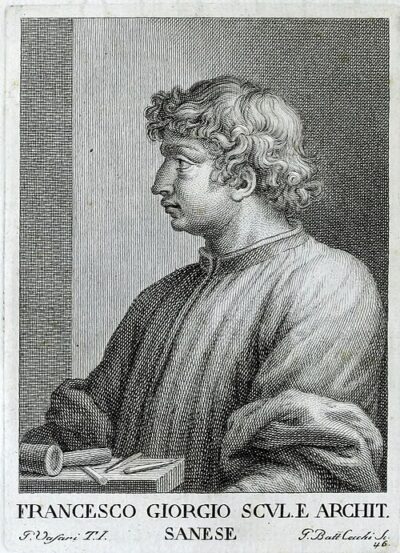
Francesco di Giorgio
Francesco di Giorgio was an Italian Renaissance architect, sculptor and painter. Born September 23, 1439, in Siena. Died November 29, 1501, in Siena. Known for Adoration of the Child, Trattati di architettura ingegneria e arte militare and Stonework from the Rocca Roveresca of Mondolfo.
Facts
14 facts · 2 confirmed by two sources · 8 cited · 4 from one source
Where this comes from
Papalocal keeps its own record. It started from these sources; what each one said is kept here as it was copied, so a change on their side never changes this page by itself. Tap one to read its version.
What Wikidata says · copied November 16, 2026 · revision 2559121489
- Described as
- Italian Renaissance architect, sculptor and painter (1439-1502)
- Other names
- Francesco di Giorgio Martini, Francesco Maurizio di Giorgio di Martino Pollaiuolo, Francesco Maurizo di Giorgio di Martini Pollaiuolo, Francesco Di Giorgio Martini, Francesco Maurizio Di Giorgio, Francesco Di Giorgio, Francesco Maurizio di Giorgio Martini Pollaiolo, Francesco di Giorgio Martini., francesco maurizio di giorgio, martini francesco di giorgio, francesco di giorgio martini
- Born
- September 23, 1439 · 1 reference
- Died
- November 29, 1501
- Born in
- Siena · 1 reference
- Died in
- Siena · 1 reference
- Citizen of
- Italy · 1 reference
- Occupation
- painter · 2 references; architect · 2 references; sculptor · 1 reference; writer · 1 reference; medalist · 1 reference; draftsperson · 1 reference
- Known for
- Adoration of the Child; Trattati di architettura ingegneria e arte militare; Stonework from the Rocca Roveresca of Mondolfo · 1 reference
- Wikipedias with a page
- 31
Wikidata item Q434425 (wikidata.org/wiki/Q434425), public domain (CC0). Copied November 16, 2026.
What Wikipedia says · copied November 16, 2026 · revision 1370412575
Francesco di Giorgio Martini (1439–1501) was an Italian architect, engineer, painter, sculptor, and writer. As a painter, he belonged to the Sienese School. He was considered a visionary architectural theorist—in Nikolaus Pevsner's terms: "one of the most interesting later Quattrocento architects". As a military engineer, he executed architectural designs and sculptural projects and built almost seventy fortifications for the Federico da Montefeltro, Count (later Duke) of Urbino, building city walls and early examples of star-shaped fortifications.
Born in Siena, he apprenticed as a painter with Vecchietta. In panels painted for cassoni he departed from the traditional representations of joyful wedding processions in frieze-like formulas to express visions of ideal, symmetrical, vast and all but empty urban spaces rendered in perspective.
He composed an architectural treatise Trattato di architettura, ingegneria e arte militare, the third of the Quattrocento, after Leone Battista Alberti's and Filarete's; he worked on it for decades and finished sometime after 1482; it circulated in manuscript. The treatise was included in several original manuscripts with one copy (i.e., Codex Mediceo Laurenziano 361) belonged to Leonardo da Vinci who had made notes and sketches within. The projects were well in advance of completed projects at the time, but innovations, for example in staircase planning, running in flights and landings round an open center, or dividing at a landing to return symmetrically on each wall, became part of architectural vocabulary in the following century. The third book is preoccupied with the "ideal" city, constrained within star-shaped polygonal geometries reminiscent of the star fort, whose wedge-shaped bastions are said to have been his innovation.Francesco di Giorgio finished his career as the architect in charge of the works at the Duomo di Siena, where his bronze angels are on the high altar and some marble floor mosaics are attributed to his designs. The design of the church of San Sebastiano in Vallepiatta in Siena is also attributed to him.
Francesco di Giorgio's painting of the "Madonna and Child with 2 Angels" is found at the Lowe Art Museum in Coral Gables, Florida.
- Born, in its opening lines
- 1439
- Died, in its opening lines
- 1501
From the Wikipedia article “Francesco di Giorgio Martini” (en.wikipedia.org/wiki/Francesco_di_Giorgio_Martini), by its contributors, under CC BY-SA 4.0 (creativecommons.org/licenses/by-sa/4.0/). Copied November 16, 2026; not changed.
Confirmed Two sources agree. Cited One source, and it names where it got it. One source One source, without a reference of its own. Sources disagree The sources disagree. We show the best-supported value and keep theirs below.
