
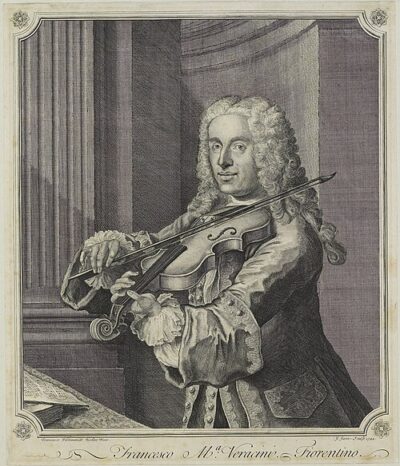
Francesco Maria Veracini
Francesco Maria Veracini was an Italian composer. Born February 1, 1690, in Florence. Died October 31, 1768, in Florence.
Facts
9 facts · 2 confirmed by two sources · 4 cited · 3 from one source
Where this comes from
Papalocal keeps its own record. It started from these sources; what each one said is kept here as it was copied, so a change on their side never changes this page by itself. Tap one to read its version.
What Wikidata says · copied November 17, 2026 · revision 2567363287
- Described as
- Italian composer
- Born
- February 1, 1690 · 10 references
- Died
- October 31, 1768 · 9 references
- Born in
- Florence · 2 references
- Died in
- Florence · 2 references
- Occupation
- composer · 1 reference; conductor; violinist · 1 reference
- Genre
- opera
- Instrument
- violin
- Wikipedias with a page
- 24
Wikidata item Q713268 (wikidata.org/wiki/Q713268), public domain (CC0). Copied November 17, 2026.
What Wikipedia says · copied November 17, 2026 · revision 1382931927
Francesco Maria Veracini (1 February 1690 – 31 October 1768) was an Italian composer and violinist, perhaps best known for his sets of violin sonatas. As a composer, according to Manfred Bukofzer, "His individual, if not subjective, style has no precedent in baroque music and clearly heralds the end of the entire era", while Luigi Torchi maintained that "he rescued the imperiled music of the eighteenth century", His contemporary, Charles Burney, held that "he had certainly a great share of whim and caprice, but he built his freaks on a good foundation, being an excellent contrapuntist". The asteroid 10875 Veracini was named after him.
- Born, in its opening lines
- February 1, 1690
- Died, in its opening lines
- October 31, 1768
From the Wikipedia article “Francesco Maria Veracini” (en.wikipedia.org/wiki/Francesco_Maria_Veracini), by its contributors, under CC BY-SA 4.0 (creativecommons.org/licenses/by-sa/4.0/). Copied November 17, 2026; not changed.
Confirmed Two sources agree. Cited One source, and it names where it got it. One source One source, without a reference of its own. Sources disagree The sources disagree. We show the best-supported value and keep theirs below.
