
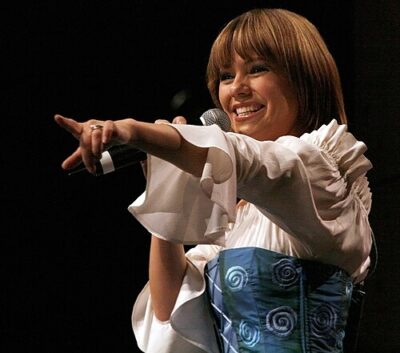
Francine Jordi is a Swiss singer and composer. Born June 24, 1977, in Worb.
Facts
9 facts · 1 confirmed by two sources · 2 cited · 6 from one source
Where this comes from
Papalocal keeps its own record. It started from these sources; what each one said is kept here as it was copied, so a change on their side never changes this page by itself. Tap one to read its version.
What Wikidata says · copied November 16, 2026 · revision 2558520418
- Described as
- Swiss singer and composer
- Other names
- Francine Lehmann
- Born
- June 24, 1977 · 2 references
- Born in
- Worb
- Citizen of
- Switzerland
- Occupation
- singer · 1 reference; composer; musician · 1 reference
- Genre
- schlager music
- Instrument
- voice
- Website
- http://www.francinejordi.ch/
- Wikipedias with a page
- 29
Wikidata item Q242355 (wikidata.org/wiki/Q242355), public domain (CC0). Copied November 16, 2026.
What Wikipedia says · copied November 16, 2026 · revision 1383661625
Francine Jordi (born Francine Lehmann, 24 June 1977) is a Swiss pop singer.
As a young child, she sang songs for Japanese tourists in Interlaken. With this musical background she won the German Grand Prix der Volksmusik in 1998 with the song "Das Feuer der Sehnsucht". Jordi subsequently became a star in Switzerland with chart success singing mostly in German and leading to golden records and tours throughout not only Switzerland, but also Germany and Austria. She hosted two TV shows at the ARD. In 2002, she represented Switzerland at the Eurovision Song Contest in Tallinn with a French language song "Dans le jardin de mon âme". In autumn that year, she made a solo tour with her band in Switzerland.
As of September 2015, Jordi has been presenter of the long-running TV show, Musikantenstadl.
- Born, in its opening lines
- June 24, 1977
From the Wikipedia article “Francine Jordi” (en.wikipedia.org/wiki/Francine_Jordi), by its contributors, under CC BY-SA 4.0 (creativecommons.org/licenses/by-sa/4.0/). Copied November 16, 2026; not changed.
Confirmed Two sources agree. Cited One source, and it names where it got it. One source One source, without a reference of its own. Sources disagree The sources disagree. We show the best-supported value and keep theirs below.
