
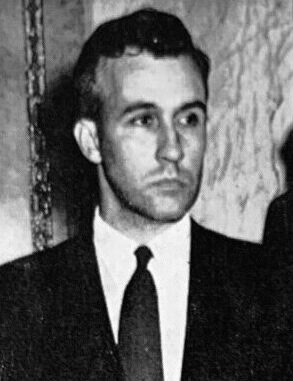
Francis Parker Yockey
Francis Parker Yockey was an American writer. Born September 18, 1917, in Chicago. Died June 17, 1960, in San Francisco. Educated at Georgetown University and University of Michigan.
Facts
17 facts · 2 confirmed by two sources · 0 cited · 15 from one source
What’s different
- Died: we show June 17, 1960 (Confirmed). Wikidata also lists June 16, 1960
Where this comes from
Papalocal keeps its own record. It started from these sources; what each one said is kept here as it was copied, so a change on their side never changes this page by itself. Tap one to read its version.
What Wikidata says · copied November 16, 2026 · revision 2551506550
- Described as
- American writer (1917-1960)
- Other names
- Ulick Varange, Francis Yockey
- Born
- September 18, 1917 · 2 references
- Died
- June 16, 1960 · 1 reference; June 17, 1960 · 1 reference
- Born in
- Chicago
- Died in
- San Francisco
- Cause of death
- cyanide poisoning
- Citizen of
- United States
- Occupation
- philosopher; writer; lawyer; politician · 1 reference
- Education
- Georgetown University; University of Michigan; University of Arizona; University of Notre Dame; Notre Dame Law School
- Instrument
- piano
- Field
- philosophy
- Wikipedias with a page
- 22
Wikidata item Q1386299 (wikidata.org/wiki/Q1386299), public domain (CC0). Copied November 16, 2026.
What Wikipedia says · copied November 16, 2026 · revision 1382465812
Francis Parker Yockey (September 18, 1917 – June 17, 1960) was an American fascist writer best known for his neo-Spenglerian book Imperium: The Philosophy of History and Politics, published in 1948 under the pen name Ulick Varange, which called for a neo-Nazi European empire.
Yockey supported far-right causes around the world and remains an influence on white nationalist and neo-fascist movements. Yockey was an antisemite, a reverent proponent of German Nazism, and an early Holocaust denier. In the 1930s, he contacted and worked with the Nazi-aligned Silver Shirts and the German-American Bund. He served in the U.S. Army in 1942–43, and went AWOL to help Nazi spies. After legal appointments in Detroit during 1944 and 1945, he worked for 11 months on the War Crimes Tribunal in Germany before he either resigned or was fired for secretly and subversively siding with the Nazis. In London, he worked for the British fascist Oswald Mosley's Union Movement, and, after falling out with Mosley, founded the breakaway European Liberation Front in 1949, leading it until it fizzled, around 1954.
During the Cold War, Yockey reportedly worked with Soviet bloc intelligence, and argued for a tactical far-right alliance with the Soviets against what he saw as Jewish-American hegemony. He also briefly wrote anti-Jewish propaganda in Egypt, where he met its then president, Gamal Abdel Nasser. Yockey remained influential in fascist circles until his suicide in FBI custody in 1960. His last visitor in prison was Willis Carto, who fervently picked up the baton, becoming the leading advocate and publisher of Yockey's writings.
- Born, in its opening lines
- September 18, 1917
- Died, in its opening lines
- June 17, 1960
From the Wikipedia article “Francis Parker Yockey” (en.wikipedia.org/wiki/Francis_Parker_Yockey), by its contributors, under CC BY-SA 4.0 (creativecommons.org/licenses/by-sa/4.0/). Copied November 16, 2026; not changed.
Confirmed Two sources agree. Cited One source, and it names where it got it. One source One source, without a reference of its own. Sources disagree The sources disagree. We show the best-supported value and keep theirs below.
