
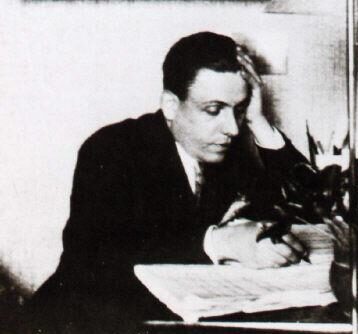
Francis Poulenc
Francis Poulenc was a French composer and pianist. Born January 7, 1899, in Paris. Died January 30, 1963, in Paris. Known for Dialogues of the Carmelites, La voix humaine and Les biches. Educated at Lycée Condorcet. Awards include Knight of the Legion of Honour and Officer of the Legion of Honour.
Facts
31 facts · 2 confirmed by two sources · 6 cited · 23 from one source
Where this comes from
Papalocal keeps its own record. It started from these sources; what each one said is kept here as it was copied, so a change on their side never changes this page by itself. Tap one to read its version.
What Wikidata says · copied November 16, 2026 · revision 2563856775
- Described as
- French composer and pianist (1899–1963)
- Other names
- Francis Jean Marcel Poulenc
- Born
- January 7, 1899 · 17 references
- Died
- January 30, 1963 · 16 references
- Born in
- Paris · 4 references
- Died in
- Paris · 4 references
- Buried in
- Père Lachaise Cemetery
- Cause of death
- myocardial infarction
- Name at birth
- Francis Jean Marcel Poulenc
- Citizen of
- France
- Occupation
- composer · 1 reference; pianist · 1 reference; music critic · 1 reference
- Education
- Lycée Condorcet
- Member of
- Groupe des Six
- Genre
- opera; classical music; religious music; choral music
- Instrument
- piano
- Known for
- Dialogues of the Carmelites; La voix humaine; Les biches; Concert champêtre; Organ Concerto; Flute Sonata; Concerto for Two Pianos and Orchestra; Gloria; Stabat Mater; Figure humaine
- Awards
- Knight of the Legion of Honour (1946) · 1 reference; Officer of the Legion of Honour (1953) · 1 reference
- Religion
- Catholicism
- Wikipedias with a page
- 57
Wikidata item Q191408 (wikidata.org/wiki/Q191408), public domain (CC0). Copied November 16, 2026.
What Wikipedia says · copied November 16, 2026 · revision 1385694209
Francis Jean Marcel Poulenc (French: [fʁɑ̃sis ʒɑ̃ maʁsɛl pulɛ̃k]; 7 January 1899 – 30 January 1963) was a French composer and pianist. His compositions include songs, solo piano works, chamber music, choral pieces, operas, ballets, and orchestral concert music. Among the best-known are the piano suite Mouvements perpétuels (1919), the ballet Les Biches (1923), the Concert champêtre (1928) for harpsichord and orchestra, the Organ Concerto (1938), the opera Dialogues des Carmélites (1957), and the Gloria (1959) for soprano, choir, and orchestra.
As the only son of a prosperous manufacturer, Poulenc was expected to follow his father into the family firm, and he was not allowed to enrol at a conservatoire. He studied with the pianist Ricardo Viñes, who became his mentor after the composer's parents died. Poulenc also made the acquaintance of Erik Satie, under whose tutelage he became one of a group of young composers known collectively as "Les Six". In his early works Poulenc became known for his high spirits and irreverence. During the 1930s a much more serious side to his nature emerged, particularly in the religious music he composed from 1936 onwards, which he alternated with his more light-hearted works.
In addition to his work as a composer, Poulenc was an accomplished pianist. He was particularly celebrated for his performing partnerships with the baritone Pierre Bernac (who also advised him in vocal writing) and the soprano Denise Duval. He toured in Europe and America with both of them, and made a number of recordings as a pianist. He was among the first composers to see the importance of the gramophone, and he recorded extensively from 1928 onwards.
In his later years, and for decades after his death, Poulenc had a reputation, particularly in his native country, as a humorous, lightweight composer, and his religious music was often overlooked. In the 21st century, more attention has been given to his serious works, with many new productions of Dialogues des Carmélites and La Voix humaine worldwide, and numerous live and recorded performances of his songs and choral music.
- Born, in its opening lines
- January 7, 1899
- Died, in its opening lines
- January 30, 1963
From the Wikipedia article “Francis Poulenc” (en.wikipedia.org/wiki/Francis_Poulenc), by its contributors, under CC BY-SA 4.0 (creativecommons.org/licenses/by-sa/4.0/). Copied November 16, 2026; not changed.
Confirmed Two sources agree. Cited One source, and it names where it got it. One source One source, without a reference of its own. Sources disagree The sources disagree. We show the best-supported value and keep theirs below.
