
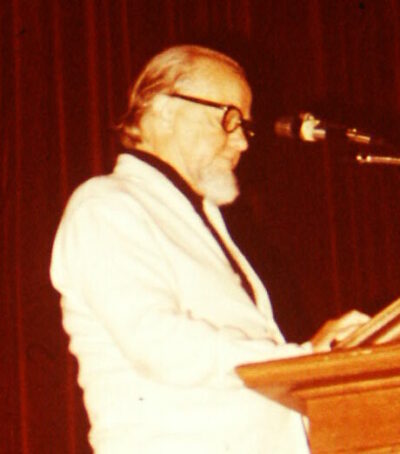
Francis Schaeffer
Francis Schaeffer was an American theologian and writer. Born January 30, 1912, in Germantown. Died May 15, 1984, in Rochester. Educated at Faith Theological Seminary and Hampden–Sydney College.
Facts
22 facts · 2 confirmed by two sources · 8 cited · 12 from one source
Where this comes from
Papalocal keeps its own record. It started from these sources; what each one said is kept here as it was copied, so a change on their side never changes this page by itself. Tap one to read its version.
What Wikidata says · copied November 16, 2026 · revision 2566147845
- Described as
- American theologian and writer (1912-1984)
- Other names
- Francis August Schaeffer, Francis A. Schaeffer
- Born
- January 30, 1912 · 1 reference
- Died
- May 15, 1984 · 2 references
- Born in
- Germantown
- Died in
- Rochester
- Citizen of
- United States
- Occupation
- philosopher; writer; pastor · 1 reference; Protestant theologian · 1 reference; theologian · 1 reference
- Education
- Faith Theological Seminary; Hampden–Sydney College · 1 reference; Westminster Theological Seminary
- Field
- Protestant theology · 1 reference; philosophy · 1 reference; pastoral care · 1 reference
- Spouse
- Edith Schaeffer · 1 reference
- Children
- Frank Schaeffer · 1 reference; Susan Schaeffer Macaulay · 1 reference
- Religion
- Presbyterianism; Evangelicalism
- Lived in
- Ollon
- Wikipedias with a page
- 21
Wikidata item Q958594 (wikidata.org/wiki/Q958594), public domain (CC0). Copied November 16, 2026.
What Wikipedia says · copied November 16, 2026 · revision 1371753673
Francis August Schaeffer (January 30, 1912 – May 15, 1984) was an American evangelical theologian, philosopher, and Presbyterian pastor. He co-founded the L'Abri community in Switzerland with his wife Edith Schaeffer, a prolific author in her own right. Opposed to theological modernism, Schaeffer promoted what he claimed was a more historic Protestant faith and a presuppositional approach to Christian apologetics, which he believed would answer the questions of the age.
Born in Germantown, Pennsylvania, he graduated with high honors from Hampden–Sydney College in 1935 and studied at Westminster and Faith Theological Seminaries. Schaeffer became the first graduate and ordained minister of the Bible Presbyterian Church and served pastorates in Pennsylvania and Missouri. In 1948, he moved with his family to Switzerland, where they founded the L’Abri community in 1955, which later expanded internationally.
Influenced by Cornelius Van Til, Herman Dooyeweerd, and Hans Rookmaaker, he argued that non-Christian worldviews are internally inconsistent and that Christianity offers a coherent foundation for truth, morality, and meaning. He called his method “Taking the roof off,” exposing contradictions in secular thinking to lead others toward Christianity. His published works include The God Who Is There, Escape from Reason, and He Is There and He Is Not Silent.
In the 1970s and 1980s, Schaeffer became a voice for evangelical political engagement, particularly around abortion and secular humanism. His 1981 book A Christian Manifesto encouraged Christians to challenge cultural pluralism while rejecting theocracy, influencing groups like Operation Rescue and shaping the Christian Right. He also co-founded the Seven Mountain Mandate, advocating Christian influence in society's key spheres, such as education, media, and government.
- Born, in its opening lines
- January 30, 1912
- Died, in its opening lines
- May 15, 1984
From the Wikipedia article “Francis Schaeffer” (en.wikipedia.org/wiki/Francis_Schaeffer), by its contributors, under CC BY-SA 4.0 (creativecommons.org/licenses/by-sa/4.0/). Copied November 16, 2026; not changed.
Confirmed Two sources agree. Cited One source, and it names where it got it. One source One source, without a reference of its own. Sources disagree The sources disagree. We show the best-supported value and keep theirs below.
