
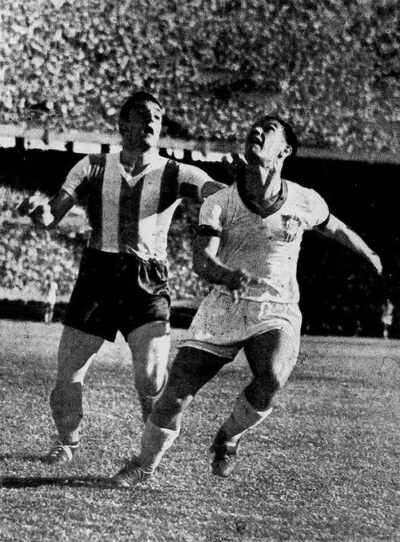
Francisco Aramburu
Francisco Aramburu was a Brazilian footballer. Born January 7, 1922, in Uruguaiana. Died October 1, 1997, in Porto Alegre. Teams include Clube de Regatas do Flamengo (1955–1956), CR Vasco da Gama (1943–1955) and Grêmio FBPA (1941–1942).
Facts
12 facts · 2 confirmed by two sources · 2 cited · 8 from one source
Where this comes from
Papalocal keeps its own record. It started from these sources; what each one said is kept here as it was copied, so a change on their side never changes this page by itself. Tap one to read its version.
What Wikidata says · copied November 17, 2026 · revision 2541747390
- Described as
- Brazilian footballer (1922-1997)
- Other names
- Chico
- Born
- January 7, 1922
- Died
- October 1, 1997 · 1 reference
- Born in
- Uruguaiana
- Died in
- Porto Alegre · 1 reference
- Citizen of
- Brazil
- Occupation
- association football player · 1 reference
- Teams
- Clube de Regatas do Flamengo (1955–1956); CR Vasco da Gama (1943–1955); Grêmio FBPA (1941–1942); Brazil men's national football team
- Sport
- association football
- Height
- 1.68 m (5 ft 6 in)
- Wikipedias with a page
- 25
Wikidata item Q927470 (wikidata.org/wiki/Q927470), public domain (CC0). Copied November 17, 2026.
What Wikipedia says · copied November 17, 2026 · revision 1382766399
Francisco Aramburu (7 January 1922 – 1 October 1997), commonly known as Chico, was a Brazilian footballer who played as a left winger.
Chico, commonly short for Francisco, commenced playing football in 1939, aged 17, in his hometown with EC Ferro Carril. A year later, he moved to the state capital Porto Alegre, where he was given the opportunity to display his skills in the colours of Grêmio. Just another year later in 1942 he followed an offer from CR Vasco da Gama in the then national capital Rio de Janeiro. the club with the Maltese cross in its crest then was the number five in town after Fluminense, Botafogo, Flamengo America-RJ.
The Uruguayan coach Ondino Viera, who before had won championships with Nacional in Montevideo, CA River Plate in Buenos Aires, joined Vasco at the same time. He not only reintroduced the since then typical kit with the diagonal strip, but also a number of tactical innovations. The former boxer Mário Américo, who would later acquire worldwide fame as the physiotherapist of the Brazil national team across seven World Cups from 1950 to 1974, was another new addition to the club.
By 1945, Viera had succeeded in establishing a competitive side and led the Vasco to the sixth state championship – undefeated. The Expresso da Vitrória as the team should be known from 1945 to 1952, benefited in particular from its strong attack with Ademir de Menezes, top scorer Lelé, Isaías, Jair da Rosa Pinto und Chico on the left wing. Chico, by then was already renowned as an athletic, fast, two-footed dribbler with a sharp shot and was soon considered for the national team.
In December 1945, he debuted for Brazil in São Paulo against Argentina in the series of matches for the Copa Roca. The hosts lost 3–4, but a few days later Brazil defeated Argentina 6–2 in the Estádio São Januário, Vasco's stadium. Chico contributed with one goal to this highest victory of Brazil against the archrival. Brazil secured the trophy in the deciding match at the same place, winning 3:1. Also, this series of matches between the two countries was marked by a very robust style. Argentina's Batagliero broke a leg in a duel with the 20-year-old Ademir.
In the 1950 FIFA World Cup, he played four games and scored four goals. He played in the famous game with Uruguay, which Brazil lost, known as "Maracanazo", ultimately resulting in Brazil's failure to win the 1950 World Cup. He was the third-highest top-scorer of the tournament, and won the Bronze Shoe award, along with Alcides Ghiggia, Telmo Zarra and Estanislau Basora.
- Born, in its opening lines
- January 7, 1922
- Died, in its opening lines
- October 1, 1997
From the Wikipedia article “Chico (footballer, born 1922)” (en.wikipedia.org/wiki/Chico_(footballer,_born_1922)), by its contributors, under CC BY-SA 4.0 (creativecommons.org/licenses/by-sa/4.0/). Copied November 17, 2026; not changed.
Confirmed Two sources agree. Cited One source, and it names where it got it. One source One source, without a reference of its own. Sources disagree The sources disagree. We show the best-supported value and keep theirs below.
