
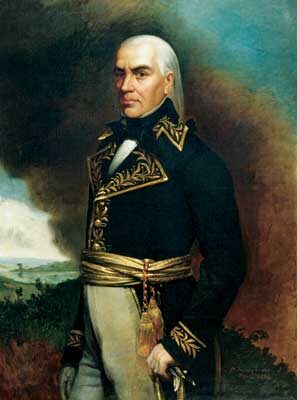
Francisco de Miranda
Francisco de Miranda was a Venezuelan military leader. Born March 28, 1750, in Caracas. Died July 14, 1816, in Cádiz. Positions held include President of Venezuela. Educated at Central University of Venezuela. Awards include list of names inscribed on the Arc de Triomphe.
Facts
16 facts · 2 confirmed by two sources · 5 cited · 9 from one source
Where this comes from
Papalocal keeps its own record. It started from these sources; what each one said is kept here as it was copied, so a change on their side never changes this page by itself. Tap one to read its version.
What Wikidata says · copied November 16, 2026 · revision 2566610032
- Described as
- Venezuelan military leader (1750–1816)
- Other names
- Sebastián Francisco de Miranda y Rodríguez de Espinoza, Francisco Sebastián de Miranda y Rodríguez de Espinosa, Don Juan Manuel de Cagigal, Sebastián Francisco de Miranda Rodríguez
- Born
- March 28, 1750 · 8 references
- Died
- July 14, 1816 · 7 references
- Born in
- Caracas · 3 references
- Died in
- Cádiz · 2 references
- Buried in
- Cádiz Province · 1 reference
- Citizen of
- Spain; Venezuela
- Occupation
- politician · 1 reference; translator; writer; soldier · 1 reference; revolutionary · 1 reference
- Positions held
- President of Venezuela
- Education
- Central University of Venezuela
- Awards
- list of names inscribed on the Arc de Triomphe
- Father
- Sebastián de Miranda Ravelo
- Wikipedias with a page
- 49
Wikidata item Q311447 (wikidata.org/wiki/Q311447), public domain (CC0). Copied November 16, 2026.
What Wikipedia says · copied November 16, 2026 · revision 1385374077
Sebastián Francisco de Miranda y Rodríguez de Espinoza (28 March 1750 – 14 July 1816), commonly known as Francisco de Miranda (Latin American Spanish: [fɾanˈsisko ðe miˈɾanda]), was a Venezuelan military leader and revolutionary who fought in the American Revolutionary War, the French Revolution and the Spanish American wars of independence. He is regarded as a precursor of South America's liberation from the Spanish Empire, and remains known as the "First Universal Venezuelan" and the "Great Universal American".
Born in Caracas in the Viceroyalty of New Granada into a wealthy family, Miranda left to pursue an education in Madrid in 1771 and subsequently enlisted in the Spanish army.
In 1780, following Spain's entry into the American Revolutionary War, he was sent to Cuba and fought the British at Pensacola. Accused of espionage and smuggling, he fled to the United States in 1783. Miranda returned to Europe in 1785 and travelled through the continent, gradually formulating his plans for Spanish American independence. From 1791 on, he took an active part in the French Revolution, serving as a general during the Battle of Valmy and the Flanders campaign. An associate of the Girondins, he became disillusioned by the Revolution and was forced to leave for Britain.
In 1806, Miranda launched an unsuccessful expedition to liberate Venezuela with volunteers from the United States. He returned to Caracas following the outbreak of the Venezuelan War of Independence in 1810 and was granted dictatorial powers after the establishment of the First Republic. In 1812, the republic collapsed and Miranda was forced to finalize an armistice with Spanish royalists. Other revolutionary leaders including Simón Bolívar considered his capitulation treasonous, and allowed his arrest by the Spanish authorities. He was taken to a prison in Cádiz, where he died four years later.
- Born, in its opening lines
- March 28, 1750
- Died, in its opening lines
- July 14, 1816
From the Wikipedia article “Francisco de Miranda” (en.wikipedia.org/wiki/Francisco_de_Miranda), by its contributors, under CC BY-SA 4.0 (creativecommons.org/licenses/by-sa/4.0/). Copied November 16, 2026; not changed.
Confirmed Two sources agree. Cited One source, and it names where it got it. One source One source, without a reference of its own. Sources disagree The sources disagree. We show the best-supported value and keep theirs below.
