
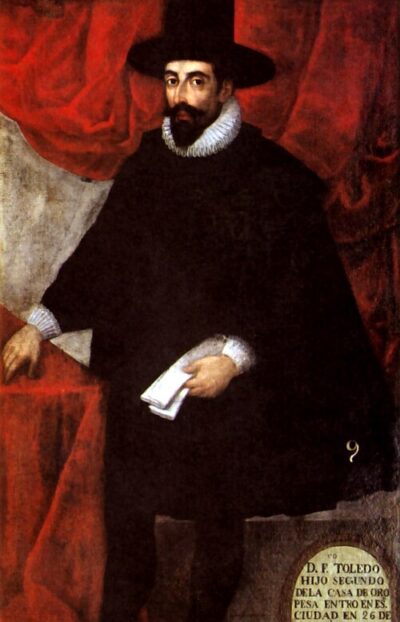
Francisco de Toledo, Count of Oropesa
Francisco de Toledo, Count of Oropesa was a Viceroy of Peru. Born July 10, 1515, in Oropesa. Died April 21, 1582, in Escalona. Positions held include Viceroy of Peru.
Facts
12 facts · 2 confirmed by two sources · 3 cited · 7 from one source
Where this comes from
Papalocal keeps its own record. It started from these sources; what each one said is kept here as it was copied, so a change on their side never changes this page by itself. Tap one to read its version.
What Wikidata says · copied November 18, 2026 · revision 2570499598
- Described as
- Viceroy of Peru (1515-1582)
- Other names
- el gran organizador
- Born
- July 10, 1515
- Died
- April 21, 1582
- Born in
- Oropesa · 1 reference
- Died in
- Escalona
- Buried in
- Toledo Province
- Citizen of
- Spain
- Occupation
- politician · 1 reference; military personnel · 1 reference
- Positions held
- Viceroy of Peru
- Field
- politics · 1 reference
- Father
- Francisco Álvarez de Toledo y Pacheco
- Religion
- Catholicism
- Wikipedias with a page
- 24
Wikidata item Q186805 (wikidata.org/wiki/Q186805), public domain (CC0). Copied November 18, 2026.
What Wikipedia says · copied November 18, 2026 · revision 1380675896
Francisco Álvarez de Toledo (Oropesa, 10 July 1515 – Escalona, 21 April 1582), also known as The Viceroyal Solon, was a Spanish aristocrat and soldier of the Kingdom of Spain and the Spanish Empire’s fifth Viceroy of Peru. Often regarded as the "most important of Peru's viceroys", his administration is notable for its devastating impact on the American Indians of Peru.
Toledo brought stability to a tumultuous viceroyalty of Spain and enacted administrative policies which changed the character of Spanish colonial rule and the relationship between the American Indians of the Andes and their Spanish colonial overlords. Leading a policy of "reductions", Toledo forcibly relocated about 1.4 million American Indians of Peru and Bolivia into new settlements in order to enforce their Christianization, collect tributes and taxes, and gather American Indian labor to work in mines and other Spanish enterprises. This policy increased the demands on forced labor compared to that of mit'a in the Inca Empire. He also executed Túpac Amaru, the last Inca chief of the Neo-Inca State in Vilcabamba.
Toledo held the position of viceroy from November 30, 1569, until 1 May 1581, a total of eleven years and five months. He has been praised as the "supreme organizer" of the immense viceroyalty, giving it a legal structure and strengthening institutions by which the Spanish colony functioned for more than two hundred years. Scholar John Hemming described Toledo as "one of the world's great colonial administrators". He also described him as "honest and honorable but cold and unfeeling...autocratic" and "with the temperament of an ascetic."
- Born, in its opening lines
- July 10, 1515
- Died, in its opening lines
- April 21, 1582
From the Wikipedia article “Francisco de Toledo” (en.wikipedia.org/wiki/Francisco_de_Toledo), by its contributors, under CC BY-SA 4.0 (creativecommons.org/licenses/by-sa/4.0/). Copied November 18, 2026; not changed.
Confirmed Two sources agree. Cited One source, and it names where it got it. One source One source, without a reference of its own. Sources disagree The sources disagree. We show the best-supported value and keep theirs below.
