
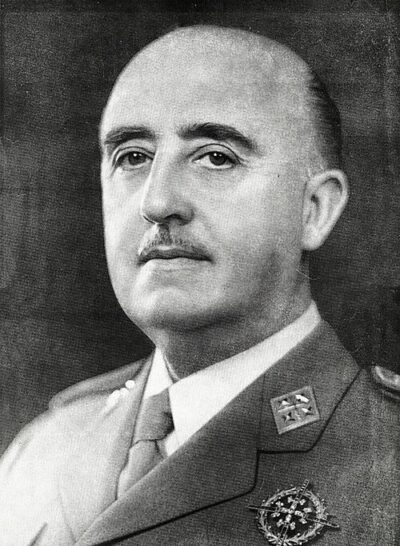
Francisco Franco
Francisco Franco was a Spanish general and dictator. Born December 4, 1892, in Ferrol. Died November 20, 1975, in Madrid. Positions held include head of government of Spain (1936–1973), Chief of Staff of the Army (1935–1936) and Director of the General Military Academy (1928–1931). Educated at Toledo Infantry Academy. Awards include Imperial Order of the Yoke and Arrows, Knight Grand Cross with Collar of the Order of Alfonso X and Knight Grand Cross of the Order of Saint Ferdinand.
Facts
59 facts · 2 confirmed by two sources · 25 cited · 32 from one source
Where this comes from
Papalocal keeps its own record. It started from these sources; what each one said is kept here as it was copied, so a change on their side never changes this page by itself. Tap one to read its version.
What Wikidata says · copied November 16, 2026 · revision 2567592135
- Described as
- Spanish general and dictator (1892–1975)
- Other names
- General Franco, El Caudillo, Generalisimo, Jakim Boor, Francisco Franco y Bahamonde, Franco, Francisco Paulino Hermenegildo Teodulo Franco y Bahamonde, Jaime de Andrade, Francisco Franco Bahamonde, Generalísimo
- Born
- December 4, 1892 · 17 references
- Died
- November 20, 1975 · 17 references
- Born in
- Ferrol · 2 references
- Died in
- Madrid · 3 references
- Buried in
- Grave of Francisco Franco at Mingorrubio Cemetery (2019–) · 1 reference
- Cause of death
- heart failure
- Name at birth
- Francisco Paulino Hermenegildo Teódulo Franco Bahamonde
- Citizen of
- Spain
- Occupation
- military officer; spanish legionary; military leader; politician · 1 reference; governor; screenwriter · 1 reference; film actor · 1 reference
- Positions held
- head of government of Spain (1936–1973); Chief of Staff of the Army (1935–1936) · 1 reference; Director of the General Military Academy (1928–1931) · 2 references; Head of State of Spain (1936–1975); commander-in-chief (1920–) · 1 reference; National Head of the Movement; Capitán general de las Islas Baleares (1933–1935) · 2 references; general in chief (1935) · 1 reference; Capitán General de Canarias (1936) · 2 references
- Political party
- Falange Española Tradicionalista y de las JONS
- Education
- Toledo Infantry Academy (–1910)
- Member of
- Francisco Franco and Carmen Polo
- Awards
- Imperial Order of the Yoke and Arrows; Knight Grand Cross with Collar of the Order of Alfonso X (1940) · 1 reference; Knight Grand Cross of the Order of Saint Ferdinand (1939) · 1 reference; Medal of Suffering for the Fatherland (1925) · 1 reference; War Grand Cross (1939) · 1 reference; Military Medal of Spain (1922) · 1 reference; Royal and Military Order of Maria Christina (1914) · 2 references; Grand Cross of the Cross of Military Merit with White Decoration (1934) · 1 reference; Grand Cross of the Aeronautical Merit - White Decoration · 1 reference; Grand Cross of the Royal and Military Order of Saint Hermenegild (1941) · 1 reference; Cross of Naval Merit with red badge (1926) · 2 references; Cross of Military Merit with Red Decoration (1912) · 2 references; Knight Grand Officer of the Order of Saint Hermenegild (1935) · 1 reference; Cross of the Royal and Military Order of Saint Hermenegild · 1 reference; Order of the Medhauia
- Spouse
- María del Carmen Polo Martínez-Valdés (1923–1975)
- Children
- Carmen Franco, 1st Duchess of Franco · 1 reference
- Father
- Nicolás Franco Salgado-Araújo
- Mother
- Pilar Bahamonde y Pardo de Andrade
- Siblings
- Pilar Franco Bahamonde; Nicolás Franco Bahamonde; Ramón Franco Bahamonde; Eugenio Franco Puey; María de la Paz Franco Bahamonde
- Religion
- Catholicism
- Military branch
- Spanish Armed Forces (1939-1975) · 1 reference
- Military rank
- general de división (1934–1938); generalissimo (1936–); brigadier general (1926–1934)
- Lived in
- Royal Palace of El Pardo (1939–1975); Pazo de Meirás
- Height
- 1.63 m (5 ft 4 in)
- Wikipedias with a page
- 134
Wikidata item Q29179 (wikidata.org/wiki/Q29179), public domain (CC0). Copied November 16, 2026.
What Wikipedia says · copied November 16, 2026 · revision 1385506827
Francisco Franco Bahamonde (4 December 1892 – 20 November 1975) was a Spanish military general and the dictator of Spain from 1939 until his death in 1975. He had led the Nationalist forces in overthrowing the Second Spanish Republic during the Spanish Civil War from 1936 to 1939. This period in Spanish history, from the Nationalist victory to Franco's death, is commonly known as Francoist Spain.
Born in Ferrol, Galicia, into an upper-class military family, Franco served in the Spanish Army as a cadet in the Toledo Infantry Academy from 1907 to 1910. While serving in Morocco, he rose through the ranks to become a brigadier general in 1926 at age 33. Two years later, Franco became the director of the General Military Academy in Zaragoza. As a conservative and monarchist, Franco regretted the abolition of the monarchy and the establishment of the Second Republic in 1931, and was devastated by the closing of his academy; nevertheless, he continued his service in the Republican Army. His career was boosted after the right-wing CEDA and PRR won the 1933 election, empowering him to lead the suppression of the 1934 uprising in Asturias. Franco was briefly elevated to Chief of Army Staff before the 1936 election moved the leftist Popular Front into power, relegating him to the Canary Islands.
Franco joined the July 1936 military coup, which, after failing to take Spain, sparked the Spanish Civil War. He commanded Spain's African colonial army.
Later, following the deaths of much of the rebel leadership, he became his faction's only leader, and was appointed generalissimo and head of state in 1936. He became recognised as a fascist leader while receiving support from Fascist Italy and Nazi Germany. He consolidated all Nationalist groups into the FET y de las JONS (also known as the Movimiento Nacional), and developed a cult of personality around his rule. Three years later the Nationalists declared victory, which extended Franco's rule over Spain through a period of extreme repression of political opponents. His government's use of forced labour, concentration camps and executions after the war led to at least 30,000 deaths, with some estimates exceeding 200,000. Combined with wartime killings, this brings the death toll of the White Terror to between 100,000 and 350,000 or more. During World War II, he maintained Spanish neutrality, but supported the Axis powers, damaging the country's international reputation.
In the late 1950s, Franco lifted Spain out of its mid-20th century economic depression through technocratic and economically liberal policies, presiding over a period of accelerated growth known as the "Spanish miracle". At the same time, his regime transitioned from a totalitarian state to an authoritarian one with limited pluralism. He became a leader in the anti-communist movement, garnering support from the West, particularly the United States. As the government relaxed its hard-line policies, Luis Carrero Blanco became Franco's éminence grise, whose role expanded after Franco began struggling with Parkinson's disease in the 1960s. In 1973, Franco resigned as prime minister—separated from the office of head of state since 1967—due to his advanced age and illness. Nevertheless, he remained in power as the head of state and as commander-in-chief. Franco died in 1975, aged 82, and was entombed in the Valley of the Fallen. He restored the monarchy in his final years, being succeeded by King Juan Carlos, who led the Spanish transition to democracy.
The legacy of Franco in Spanish history remains controversial, as the nature of his rule changed over time. His reign was marked by both severe repression, with tens of thousands killed, and economic prosperity, which greatly improved the quality of life in Spain. His style proved adaptable enough to allow social and economic reform, but still centred on highly authoritarian nationalism. Contemporaries regarded Franco as a fascist dictator.
Among scholars, by contrast, there has been a long-lasting debate whether it is adequate to define Franco's regime as fascist. It has been described in broad definitions, from a traditional military dictatorship to a para-fascist or a fully fascist regime.
- Born, in its opening lines
- December 4, 1892
- Died, in its opening lines
- November 20, 1975
From the Wikipedia article “Francisco Franco” (en.wikipedia.org/wiki/Francisco_Franco), by its contributors, under CC BY-SA 4.0 (creativecommons.org/licenses/by-sa/4.0/). Copied November 16, 2026; not changed.
Confirmed Two sources agree. Cited One source, and it names where it got it. One source One source, without a reference of its own. Sources disagree The sources disagree. We show the best-supported value and keep theirs below.
