
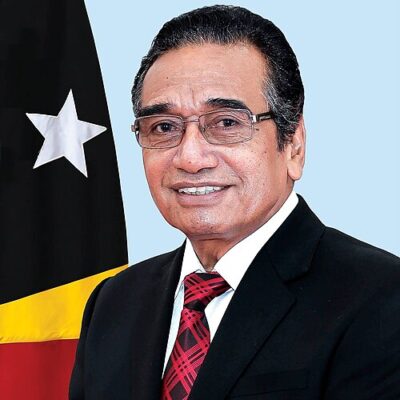
Francisco Guterres
Francisco Guterres was an East Timorese politician. Born September 7, 1954, in Ossu. Died June 21, 2026, in Kuala Lumpur. Positions held include Speaker of the National Parliament of Timor-Leste (2002–2007) and President of East Timor (2017–2022). Awards include Order of Timor-Leste, Medal of Merit and Grand Collar of the Order of Prince Henry.
Facts
13 facts · 2 confirmed by two sources · 1 cited · 10 from one source
Where this comes from
Papalocal keeps its own record. It started from these sources; what each one said is kept here as it was copied, so a change on their side never changes this page by itself. Tap one to read its version.
What Wikidata says · copied November 16, 2026 · revision 2563045467
- Described as
- East Timorese politician (1954-2026)
- Other names
- Lu-Olo, Lú-Olo
- Born
- September 7, 1954 · 2 references
- Died
- June 21, 2026 · 1 reference
- Born in
- Ossu
- Died in
- Kuala Lumpur
- Citizen of
- Timor-Leste
- Occupation
- politician · 1 reference
- Positions held
- Speaker of the National Parliament of Timor-Leste (2002–2007); President of East Timor (2017–2022) · 1 reference
- Political party
- Revolutionary Front for an Independent East Timor
- Awards
- Order of Timor-Leste; Medal of Merit; Grand Collar of the Order of Prince Henry (2022)
- Spouse
- Cidália Guterres · 1 reference
- Wikipedias with a page
- 49
Wikidata item Q897790 (wikidata.org/wiki/Q897790), public domain (CC0). Copied November 16, 2026.
What Wikipedia says · copied November 16, 2026 · revision 1385884488
Francisco Guterres (7 September 1954 – 21 June 2026), popularly known by his nom de guerre Lú-Olo, was an East Timorese revolutionary and politician who served as the 6th president of Timor-Leste from 2017 to 2022. A member of Fretilin, he was a leading figure in the East Timorese armed resistance during the Indonesian occupation of East Timor.
Born in Ossu, in 1969 Guterres went to Dili, the capital of Portuguese Timor, to attend secondary school. After a brief stint working in Ossu, he returned to Dili in 1974, where he became involved in the growing anti-colonial movement and joined Fretilin. After the Indonesian invasion of East Timor in December 1975, he fled to the mountains and joined a unit of Falintil, Fretilin's armed wing. He spent the entirety of the 24-year Indonesian occupation as a guerrilla, evading capture and gradually rising through the ranks of Falintil. Following Nino Konis Santana's death in 1998, he became leader of Fretilin.
Guterres returned to civilian life before the 1999 East Timorese independence referendum. In 2001, he was elected speaker of the Constituent Assembly, a precursor to the East Timorese parliament that was responsible for drafting the new country's constitution. Upon independence in 2002, he became the first president of Timor-Leste's National Parliament, serving until 2007. Guterres stood for Fretilin in the 2007 and 2012 presidential elections, but was defeated in the second round by independent candidates both times. He was elected president in the 2017 election, supported by former prime minister Xanana Gusmão and his CNRT party. Guterres ran for reelection in 2022, but was defeated in a landslide in the second round by José Ramos-Horta.
- Born, in its opening lines
- September 7, 1954
- Died, in its opening lines
- June 21, 2026
From the Wikipedia article “Francisco Guterres” (en.wikipedia.org/wiki/Francisco_Guterres), by its contributors, under CC BY-SA 4.0 (creativecommons.org/licenses/by-sa/4.0/). Copied November 16, 2026; not changed.
Confirmed Two sources agree. Cited One source, and it names where it got it. One source One source, without a reference of its own. Sources disagree The sources disagree. We show the best-supported value and keep theirs below.
