
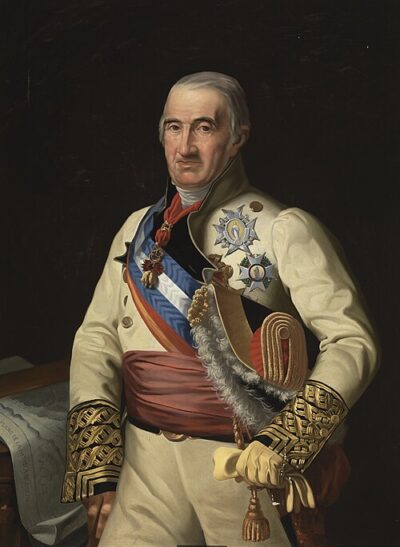
Francisco Javier Castaños, 1st Duke of Bailén
Francisco Javier Castaños, 1st Duke of Bailén was a Spanish general during the Peninsular War. Born April 22, 1758, in Madrid. Died September 24, 1852, in Madrid. Positions held include member of the Senate of Spain (1834–1852), Duke of Bailén (1833–1852) and Captain General of Catalonia (1815–1820). Educated at Royal Seminary of Nobles of Madrid and Royal Military Academy of Mathematics and Fortification. Awards include Knight of the Order of the Golden Fleece, Grand Cross of the Order of Charles III and Grand Cross of the Royal and Military Order of Saint Hermenegild.
Facts
26 facts · 0 confirmed by two sources · 1 cited · 23 from one source · 2 where the sources disagree
What’s different
- Born: we show April 22, 1758 (Sources disagree). Wikipedia says September 24, 1758
- Died: we show September 24, 1852 (Sources disagree). Wikipedia says April 22, 1852
Where this comes from
Papalocal keeps its own record. It started from these sources; what each one said is kept here as it was copied, so a change on their side never changes this page by itself. Tap one to read its version.
What Wikidata says · copied November 18, 2026 · revision 2564783357
- Described as
- Spanish general during the Peninsular War (1758-1852)
- Other names
- Castaños
- Born
- April 22, 1758 · 4 references
- Died
- September 24, 1852 · 4 references
- Born in
- Madrid
- Died in
- Madrid
- Buried in
- Pantheon of Illustrious Men (–1963); Iglesia de la Encarnación, Bailén (Jaén) (1963–)
- Name at birth
- Francisco Javier Castaños Aragorri Urioste y Olavide
- Citizen of
- Spain
- Occupation
- military officer; military personnel; politician; military leader · 1 reference
- Positions held
- member of the Senate of Spain (1834–1852); Duke of Bailén (1833–1852); Captain General of Catalonia (1815–1820); President of the Council of Castile (1832–1834)
- Education
- Royal Seminary of Nobles of Madrid; Royal Military Academy of Mathematics and Fortification
- Awards
- Knight of the Order of the Golden Fleece; Grand Cross of the Order of Charles III · 1 reference; Grand Cross of the Royal and Military Order of Saint Hermenegild
- Father
- Juan Felipe Castaños y Urioste
- Military branch
- Spanish Army (1768–1852)
- Military rank
- captain (1768–1782); Sergeant Major (1782–1784); Lieutenant Colonel (1784–1789)
- Wikipedias with a page
- 20
Wikidata item Q420319 (wikidata.org/wiki/Q420319), public domain (CC0). Copied November 18, 2026.
What Wikipedia says · copied November 18, 2026 · revision 1353012703
Francisco Javier Castaños Aragorri, 1st Duke of Bailén (24 September 1758 – 22 April 1852) was a Spanish Army officer and politician who served in the French Revolutionary and Napoleonic Wars. He presided over the Regency Council of Spain and the Indies (de facto head of state), in 1810. From July to September 1834, Castaños served as the first president of the Senate of Spain, at that time called the House of Peers.
Castaños is remembered for his victory over the French under Dupont, whom he surrounded and compelled to surrender at the decisive Battle of Bailen in 1808, where the Napoleonic army was defeated in the open field for the first time and which led to King Joseph having to abandon Madrid at the end of that same month. Just months later he led his army to a decisive defeat at the Battle of Tudela. After this he served under Wellington in several engagements, and was commander of the Spanish army, if required, to invade France in 1815.
In 1833, Ferdinand VII created him Duke of Bailén, to honour his actions during the Peninsular War and, especially, at the Battle of Bailén.
- Born, in its opening lines
- September 24, 1758
- Died, in its opening lines
- April 22, 1852
From the Wikipedia article “Francisco Javier Castaños, 1st Duke of Bailén” (en.wikipedia.org/wiki/Francisco_Javier_Castaños,_1st_Duke_of_Bailén), by its contributors, under CC BY-SA 4.0 (creativecommons.org/licenses/by-sa/4.0/). Copied November 18, 2026; not changed.
Confirmed Two sources agree. Cited One source, and it names where it got it. One source One source, without a reference of its own. Sources disagree The sources disagree. We show the best-supported value and keep theirs below.
