
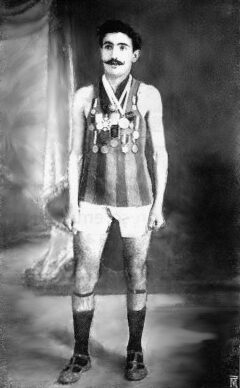
Francisco Lázaro
Francisco Lázaro was a Portuguese distance runner. Born January 21, 1888, in Benfica. Died July 15, 1912, in Stockholm.
Facts
9 facts · 2 confirmed by two sources · 1 cited · 6 from one source
What’s different
- Born: we show January 21, 1888 (Confirmed). Wikidata also lists January 21, 1891 and January 8, 1891
Where this comes from
Papalocal keeps its own record. It started from these sources; what each one said is kept here as it was copied, so a change on their side never changes this page by itself. Tap one to read its version.
What Wikidata says · copied November 17, 2026 · revision 2541850386
- Described as
- Portuguese distance runner (1891–1912)
- Other names
- Francisco Lazaro
- Born
- January 21, 1891; January 21, 1888 · 1 reference; January 8, 1891 · 2 references
- Died
- July 15, 1912
- Born in
- Benfica
- Died in
- Stockholm
- Buried in
- Benfica Cemetery · 1 reference
- Citizen of
- Portugal
- Occupation
- marathon runner; long-distance runner
- Sport
- athletics
- Wikipedias with a page
- 25
Wikidata item Q443027 (wikidata.org/wiki/Q443027), public domain (CC0). Copied November 17, 2026.
What Wikipedia says · copied November 17, 2026 · revision 1372928123
Francisco Lázaro (21 January 1888 – 15 July 1912) was a Portuguese Olympic marathon runner and Portugal's standard-bearer in their first-ever participation at the Olympic Games, the 1912 Summer Olympics in Stockholm, Sweden. He is known for having died of severe electrolyte imbalance during his Olympic competition, caused by an inability to properly perspire due to having covered his body in suet to prevent sunburn.
- Born, in its opening lines
- January 21, 1888
- Died, in its opening lines
- July 15, 1912
From the Wikipedia article “Francisco Lázaro” (en.wikipedia.org/wiki/Francisco_Lázaro), by its contributors, under CC BY-SA 4.0 (creativecommons.org/licenses/by-sa/4.0/). Copied November 17, 2026; not changed.
Confirmed Two sources agree. Cited One source, and it names where it got it. One source One source, without a reference of its own. Sources disagree The sources disagree. We show the best-supported value and keep theirs below.
