
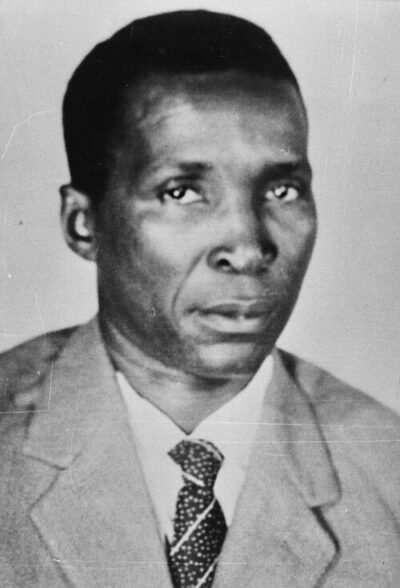
Francisco Macías Nguema Biyoko
Francisco Macías Nguema Biyoko was an Equatoguinean politician, 1st and former President of Equatorial Guinea. Born January 1, 1924, in Mongomo. Died September 29, 1979, in Black Beach. Positions held include President of Equatorial Guinea (1968–1979). Awards include Collar of the Spanish Order of the Civil Merit, Order of Independence and National Order of Equatorial Guinea.
Facts
20 facts · 2 confirmed by two sources · 4 cited · 14 from one source
Where this comes from
Papalocal keeps its own record. It started from these sources; what each one said is kept here as it was copied, so a change on their side never changes this page by itself. Tap one to read its version.
What Wikidata says · copied November 16, 2026 · revision 2563039712
- Described as
- Equatoguinean politician, 1st and former President of Equatorial Guinea (1924-1979)
- Other names
- Francisco Macias Nguema, Macías Nguema, Macías Nguema Biyogho Negue Ndong, Masie Nguema Biyogo Ñegue Ndong, Mez-m Ngueme
- Born
- January 1, 1924 · 3 references
- Died
- September 29, 1979 · 3 references
- Born in
- Mongomo · 1 reference
- Died in
- Black Beach
- Buried in
- Malabo cemetery
- Cause of death
- gunshot wound
- Name at birth
- Mez-m Ngueme
- Citizen of
- Equatorial Guinea · 2 references
- Occupation
- politician · 1 reference
- Positions held
- President of Equatorial Guinea (1968–1979) · 1 reference
- Political party
- United National Workers' Party (1970–1979); Popular Idea of Equatorial Guinea (2 times) (1958–1970); National Liberation Movement of Equatorial Guinea (1966–1968); National Unity Movement of Equatorial Guinea (1963–1966)
- Awards
- Collar of the Spanish Order of the Civil Merit (1968) · 1 reference; Order of Independence; National Order of Equatorial Guinea
- Children
- Mónica Macías; Filiberto Ntutumu Nguema
- Siblings
- Santiago Nguema Eneme Obama
- Wikipedias with a page
- 57
Wikidata item Q211936 (wikidata.org/wiki/Q211936), public domain (CC0). Copied November 16, 2026.
What Wikipedia says · copied November 16, 2026 · revision 1381399154
Francisco Macías Nguema (born Mez-m Ngueme, later Africanised to Masie Nguema Biyogo Ñegue Ndong; 1 January 1924 – 29 September 1979), often referred to as Macías Nguema or simply Macías, was an Equatoguinean politician who served as the first president of Equatorial Guinea from the country's gaining of independence in 1968, until his overthrow in 1979. He is widely remembered as one of the most brutal dictators in history. As president, he exhibited bizarre and erratic behavior, to the point that many of his contemporaries believed he was insane.
A member of the Fang people, Macías Nguema held numerous official positions under Spanish colonial rule before being elected the first president of the soon-to-be independent country in 1968. Early in his rule, he consolidated power by establishing an extreme cult of personality and a one-party state ruled by his United National Workers' Party (PUNT), and declaring himself president for life in 1972.
As President, he lacked a coherent political ideology, notably identifying as a "Hitlerian-Marxist" at one point. Domestically, his presidency was characterized by attempts at Africanization and harsh persecution of non-Fang ethnic groups. In foreign policy, he quickly turned against Spain and allied himself with the Eastern Bloc, receiving support from the Soviet Union, Cuba and North Korea, and to a lesser extent, France and its local allies such as Cameroonian President Ahmadou Ahidjo and Gabonese President Omar Bongo, although relations with Cameroon and Gabon collapsed by 1976. Due to his dictatorship's severe human rights abuses and economic mismanagement, tens of thousands of people fled the country to avoid persecution. This led to Equatorial Guinea being internationally nicknamed the "Dachau of Africa". His rule also led to significant brain drain, as intellectuals and educated classes were particular targets for his persecution. In 1979, he was overthrown in a coup d'état by his nephew Teodoro Obiang Nguema Mbasogo and was subsequently tried and executed.
According to various sources, anywhere from 20,000 to 80,000 of the roughly 200,000 to 300,000 people living in the country were killed under his regime, with tens of thousands more fleeing the country. He has been compared to Pol Pot because of the violent, unpredictable, and anti-intellectual nature of his government.
- Born, in its opening lines
- January 1, 1924
- Died, in its opening lines
- September 29, 1979
From the Wikipedia article “Francisco Macías Nguema” (en.wikipedia.org/wiki/Francisco_Macías_Nguema), by its contributors, under CC BY-SA 4.0 (creativecommons.org/licenses/by-sa/4.0/). Copied November 16, 2026; not changed.
Confirmed Two sources agree. Cited One source, and it names where it got it. One source One source, without a reference of its own. Sources disagree The sources disagree. We show the best-supported value and keep theirs below.
