
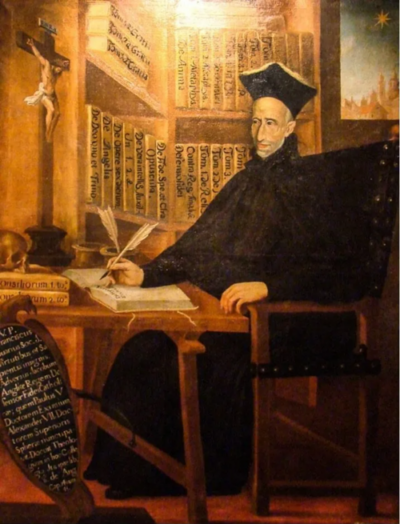
Francisco Suárez
Francisco Suárez was a Spanish Jesuit priest, philosopher and theologian. Born January 5, 1548, in Granada. Died September 25, 1617, in Lisbon. Educated at University of Salamanca.
Facts
15 facts · 2 confirmed by two sources · 6 cited · 7 from one source
Where this comes from
Papalocal keeps its own record. It started from these sources; what each one said is kept here as it was copied, so a change on their side never changes this page by itself. Tap one to read its version.
What Wikidata says · copied November 16, 2026 · revision 2568784091
- Described as
- Spanish Jesuit priest, philosopher and theologian (1548-1617)
- Other names
- Francisco Suarez
- Born
- January 5, 1548 · 4 references
- Died
- September 25, 1617 · 5 references
- Born in
- Granada · 4 references
- Died in
- Lisbon · 2 references
- Citizen of
- Spain
- Occupation
- theologian · 1 reference; philosopher · 2 references; jurist · 1 reference; university teacher; Catholic priest; Catholic theologian · 1 reference
- Worked for
- University of Salamanca; University of Coimbra
- Education
- University of Salamanca
- Religion
- Catholicism
- Wikipedias with a page
- 51
Wikidata item Q316339 (wikidata.org/wiki/Q316339), public domain (CC0). Copied November 16, 2026.
What Wikipedia says · copied November 16, 2026 · revision 1379804776
Francisco Suárez (; 5 January 1548 – 25 September 1617) was a Spanish Jesuit priest, philosopher and theologian, one of the leading figures of the School of Salamanca movement. His work is considered a turning point in the history of second scholasticism, marking the transition from its Renaissance to its Baroque phases. According to Christopher Shields and Daniel Schwartz, "figures as distinct from one another in place, time, and philosophical orientation as Leibniz, Grotius, Pufendorf, Schopenhauer and Heidegger, all found reason to cite him as a source of inspiration and influence."
- Born, in its opening lines
- January 5, 1548
- Died, in its opening lines
- September 25, 1617
From the Wikipedia article “Francisco Suárez” (en.wikipedia.org/wiki/Francisco_Suárez), by its contributors, under CC BY-SA 4.0 (creativecommons.org/licenses/by-sa/4.0/). Copied November 16, 2026; not changed.
Confirmed Two sources agree. Cited One source, and it names where it got it. One source One source, without a reference of its own. Sources disagree The sources disagree. We show the best-supported value and keep theirs below.
