
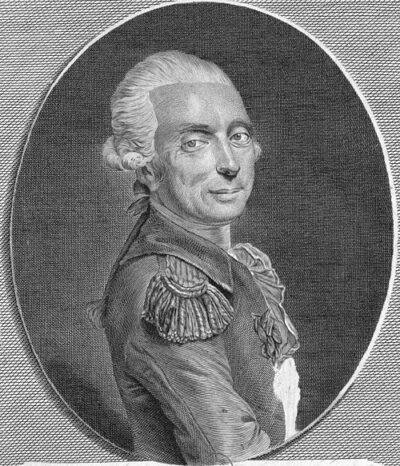
François Laurent d'Arlandes was a French marquis. Born 1742, in Anneyron. Died May 1, 1809, in Anneyron.
Facts
10 facts · 2 confirmed by two sources · 1 cited · 7 from one source
What’s different
- Born: we show 1742 (Confirmed). Wikidata also lists September 26, 1742
Where this comes from
Papalocal keeps its own record. It started from these sources; what each one said is kept here as it was copied, so a change on their side never changes this page by itself. Tap one to read its version.
What Wikidata says · copied November 18, 2026 · revision 2564346575
- Described as
- French marquis (1742-1809)
- Other names
- François Laurent d’Arlandes
- Born
- 1742 · 4 references; September 26, 1742
- Died
- May 1, 1809 · 3 references
- Born in
- Anneyron
- Died in
- Anneyron
- Citizen of
- Kingdom of France
- Occupation
- engineer; balloonist; military personnel · 1 reference; soldier · 1 reference
- Siblings
- Louis François d'Arlandes de Salton
- Wikipedias with a page
- 22
Wikidata item Q440160 (wikidata.org/wiki/Q440160), public domain (CC0). Copied November 18, 2026.
What Wikipedia says · copied November 18, 2026 · revision 1317199176
François Laurent d'Arlandes (French pronunciation: [fʁɑ̃swa loʁɑ̃ lə vjø daʁlɑ̃d]; 1742 – 1 May 1809) was a French marquis, soldier and a pioneer of hot air ballooning. He and Jean-François Pilâtre de Rozier made the first crewed free balloon flight, and first confirmed human flight of any kind, on 21 November 1783, in a Montgolfier balloon.
D'Arlandes was born in Anneyron in the Dauphiné. He met Joseph Montgolfier at the Jesuit college of Tournon. He became an infantry officer in the French royal guard.
The first public demonstration of a balloon by the Montgolfier brothers took place in June 1783, and was followed by an untethered flight of a sheep, a cockerel and a duck from the front courtyard of the Palace of Versailles on 19 September. The French King Louis XVI decided that the first manned flight would contain two condemned criminals, but de Rozier enlisted the help of the Duchess de Polignac to support his view that the honour of becoming first balloonists should belong to someone of higher status, and d'Arlandes agreed to accompany him. The King was persuaded to permit d'Arlandes and de Rozier to become the first pilots.
After several tethered tests to gain some experience of controlling the balloon, de Rozier and d'Arlandes made their first untethered flight in a Montgolfier hot air balloon on 21 November 1783, taking off at 1:54 p.m. from the garden of the Château de la Muette in the Bois de Boulogne, in the presence of the King. Also watching was U.S. envoy, Benjamin Franklin. Their 25-minute flight travelled slowly about 5½ miles (some 9 km) to the southeast, attaining an altitude of 3,000 feet, before returning to the ground at the Butte-aux-Cailles, then on the outskirts of Paris. After the flight, the pilots drank champagne to celebrate the flight, a tradition carried on by balloonists to this day.
D'Arlandes proposed a flight to cross the English Channel in 1784, but the plan came to nothing.
He was dismissed from the army for cowardice after the French Revolution, and died in his castle of Saleton near Anneyron. Some sources suggest that he committed suicide.
- Born, in its opening lines
- 1742
- Died, in its opening lines
- May 1, 1809
From the Wikipedia article “François Laurent d'Arlandes” (en.wikipedia.org/wiki/François_Laurent_d'Arlandes), by its contributors, under CC BY-SA 4.0 (creativecommons.org/licenses/by-sa/4.0/). Copied November 18, 2026; not changed.
Confirmed Two sources agree. Cited One source, and it names where it got it. One source One source, without a reference of its own. Sources disagree The sources disagree. We show the best-supported value and keep theirs below.
