
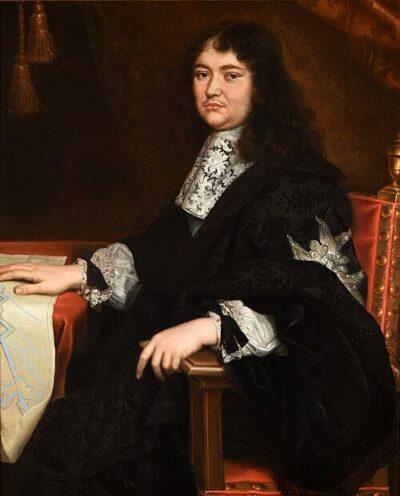
François-Michel le Tellier, Marquis de Louvois
François-Michel le Tellier, Marquis de Louvois was a Secretary of State for War under Louis XIV. Born January 18, 1641, in Paris. Died July 16, 1691, in Versailles. Positions held include Secretary of State for War of France (1677–1691), Minister for the Maison du Roi (1683–1691) and Chief Minister of France (1683–1691). Awards include Officer of the Order of the Holy Spirit and Knight of the Order of Saint Michael.
Facts
25 facts · 2 confirmed by two sources · 10 cited · 13 from one source
Where this comes from
Papalocal keeps its own record. It started from these sources; what each one said is kept here as it was copied, so a change on their side never changes this page by itself. Tap one to read its version.
What Wikidata says · copied November 16, 2026 · revision 2567867897
- Described as
- Secretary of State for War under Louis XIV (1641-1691)
- Other names
- Louvois, Francçois-Michel Le Tellier, Marquis de Louvois, Marquis of Louvois
- Born
- January 18, 1641 · 3 references
- Died
- July 16, 1691 · 8 references
- Born in
- Paris · 1 reference
- Died in
- Versailles · 1 reference
- Cause of death
- stroke
- Citizen of
- France
- Occupation
- politician · 1 reference
- Positions held
- Secretary of State for War of France (1677–1691); Minister for the Maison du Roi (1683–1691); Chief Minister of France (1683–1691); Surintendant des Bâtiments (1683–1691); governor (2 times) (1668–1675) · 1 reference
- Awards
- Officer of the Order of the Holy Spirit; Knight of the Order of Saint Michael
- Spouse
- Anne de Souvré
- Children
- Louis-Nicolas Le Tellier de Souvré; Louis François Marie Le Tellier · 1 reference; Camille Le Tellier · 1 reference; Madeleine Charlotte Le Tellier · 1 reference; Michel Courtenvau le Tellier · 1 reference; Marguerite le Tellier de Louvois
- Father
- Michel Le Tellier · 1 reference
- Mother
- Elisabeth Turpin de Vauvredin · 1 reference
- Siblings
- Madeleine Fare Le Tellier; Charles Maurice Le Tellier · 1 reference
- Wikipedias with a page
- 31
Wikidata item Q441378 (wikidata.org/wiki/Q441378), public domain (CC0). Copied November 16, 2026.
What Wikipedia says · copied November 16, 2026 · revision 1385644957
François Michel Le Tellier, Marquis de Louvois (French: [fʁɑ̃swa miʃɛl lə təlje maʁki də luvwa]; 18 January 1641 – 16 July 1691) was the French Secretary of State for War during a significant part of the reign of Louis XIV. He is commonly referred to as "Louvois". Together with his father, Michel le Tellier, he oversaw an increase in the numbers of the French Army, eventually reaching 340,000 soldiers – an army that would fight four wars between 1667 and 1713. Louvois was a key military and strategic advisor to Louis XIV, who transformed the French Army into an instrument of royal authority and foreign policy.
According to Cathal Nolan, he created the Régiment du Roi in 1663 and founded the Royal-Artillerie regiment in 1673. These innovations influenced military planners beyond France. Louvois sought out new wars as a means of concentrating more power and wealth in his own hands. He reorganized the French Army and exercised strict control over officers, but that resulted in slower tactical and operational response times.
He had more success upgrading logistics for armies on the move. He also improved the magazine system left by his father. He accumulated enough grain and wagons to provide his armies with 200,000 rations per day for up to six months during the Franco-Dutch War (1672-1678). This helped ensure the French king's early victories. Despite his flaws, Louvois is appreciated by historians for creating the role of civilian "minister of war".
- Born, in its opening lines
- January 18, 1641
- Died, in its opening lines
- July 16, 1691
From the Wikipedia article “François-Michel le Tellier, Marquis de Louvois” (en.wikipedia.org/wiki/François-Michel_le_Tellier,_Marquis_de_Louvois), by its contributors, under CC BY-SA 4.0 (creativecommons.org/licenses/by-sa/4.0/). Copied November 16, 2026; not changed.
Confirmed Two sources agree. Cited One source, and it names where it got it. One source One source, without a reference of its own. Sources disagree The sources disagree. We show the best-supported value and keep theirs below.
