
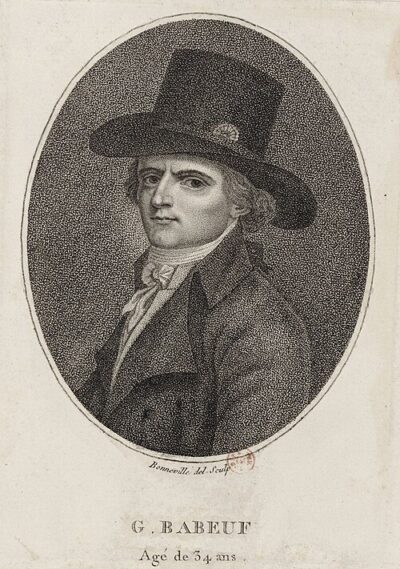
François-Noël Babeuf
François-Noël Babeuf was a French political agitator and journalist. Born November 23, 1760, in Saint-Quentin. Died May 27, 1797, in Vendôme.
Facts
18 facts · 2 confirmed by two sources · 6 cited · 10 from one source
Where this comes from
Papalocal keeps its own record. It started from these sources; what each one said is kept here as it was copied, so a change on their side never changes this page by itself. Tap one to read its version.
What Wikidata says · copied November 16, 2026 · revision 2567628343
- Described as
- French political agitator and journalist (1760-1797)
- Other names
- Gracchus Babeuf, François Noel Baboeuf, François-Noël Baboeuf, François Noël Babeuf, François-Noel Baboeuf, François Noel Babeuf
- Born
- November 23, 1760 · 6 references
- Died
- May 27, 1797 · 5 references
- Born in
- Saint-Quentin · 1 reference
- Died in
- Vendôme
- Cause of death
- decapitation
- Citizen of
- France
- Occupation
- writer · 1 reference; archivist; politician · 1 reference; journalist · 1 reference; revolutionary · 1 reference
- Political party
- Conspiracy of the Equals · 1 reference
- Field
- philosophy
- Spouse
- Marie-Anne Babeuf · 1 reference
- Children
- Émile Babeuf · 1 reference; Camille Babeuf; Caïus Babeuf
- Religion
- atheism
- Wikipedias with a page
- 57
Wikidata item Q189714 (wikidata.org/wiki/Q189714), public domain (CC0). Copied November 16, 2026.
What Wikipedia says · copied November 16, 2026 · revision 1372747232
François-Noël Babeuf (French: [fʁɑ̃swa nɔɛl babœf]; 23 November 1760 – 27 May 1797), also known as Gracchus Babeuf, was a French proto-communist, revolutionary, and journalist of the French Revolutionary period. His newspaper Le Tribun du Peuple (The Tribune of the People) was best known for its advocacy for the poor and calling for a popular revolt against the Directory, the government of France. He was a leading advocate for democracy and the abolition of private property. He made his own variant of Jacobinism (Robespierrism) which is called Neo-Jacobinism. Besides the influence of Robespierrism on his thought, due to his proto-communism, his political views were more aligned with the ideology of the Enragés. He angered the authorities who were clamping down hard on their radical enemies. In spite of the efforts of his Jacobin friends to save him, Babeuf was executed for his lead role in the Conspiracy of the Equals.
The nickname "Gracchus" likened him to the Gracchi brothers, who served as tribunes of the people in ancient Rome. Although the terms anarchist, communist and socialist were not largely used in Babeuf's lifetime, they have all been used by later scholars to describe his ideas. Communism was first used in English by John Goodwyn Barmby in a conversation with those he described as the "disciples of Babeuf". He has been called "The First Revolutionary Communist."
About his political philosophy, Babeuf wrote: "Society must be made to operate in such a way that it eradicates once and for all the desire of a man to become richer, or wiser, or more powerful than others." In the Manifesto of the Equals, a piece of writing commissioned by Babeuf, Sylvain Maréchal wrote that "[the] French Revolution [was] nothing but a precursor of another revolution, one that will be greater, more solemn, and which will be the last."
- Born, in its opening lines
- November 23, 1760
- Died, in its opening lines
- May 27, 1797
From the Wikipedia article “François-Noël Babeuf” (en.wikipedia.org/wiki/François-Noël_Babeuf), by its contributors, under CC BY-SA 4.0 (creativecommons.org/licenses/by-sa/4.0/). Copied November 16, 2026; not changed.
Confirmed Two sources agree. Cited One source, and it names where it got it. One source One source, without a reference of its own. Sources disagree The sources disagree. We show the best-supported value and keep theirs below.
