
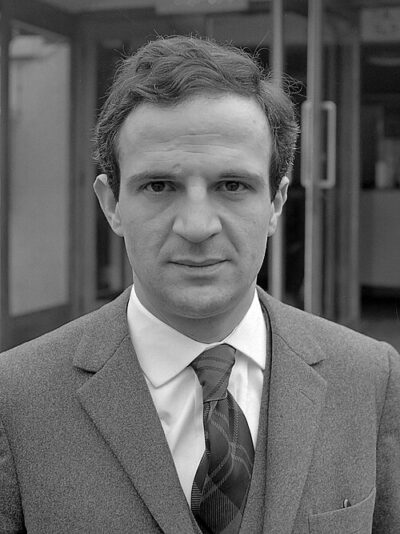
François Truffaut
François Truffaut was a French film director. Born February 6, 1932, in 17th arrondissement of Paris. Died October 21, 1984, in Neuilly-sur-Seine. Awards include Cannes Best Director Award, Bodil Award for Best Non-American Film (3 times) and Louis Delluc Prize.
Facts
42 facts · 2 confirmed by two sources · 17 cited · 23 from one source
Where this comes from
Papalocal keeps its own record. It started from these sources; what each one said is kept here as it was copied, so a change on their side never changes this page by itself. Tap one to read its version.
What Wikidata says · copied November 16, 2026 · revision 2566143183
- Described as
- French film director (1932–1984)
- Other names
- Francois Truffaut
- Born
- February 6, 1932 · 16 references
- Died
- October 21, 1984 · 15 references
- Born in
- 17th arrondissement of Paris · 1 reference
- Died in
- Neuilly-sur-Seine · 2 references
- Buried in
- Montmartre Cemetery · 1 reference
- Cause of death
- brain tumor
- Name at birth
- François Roland Truffaut · 1 reference
- Citizen of
- France · 1 reference
- Occupation
- film director · 1 reference; film producer · 1 reference; film critic · 1 reference; actor · 1 reference; director · 2 references; film screenwriter · 1 reference; producer · 1 reference; film actor · 1 reference
- Worked for
- Cahiers du cinéma
- Awards
- Cannes Best Director Award (1959); Bodil Award for Best Non-American Film (3 times) (1959, 1962, 1964); Louis Delluc Prize (1968); National Board of Review Award for Best Foreign Language Film (2 times) (1970, 1975); National Board of Review Award for Best Director (1970); New York Film Critics Circle Award for Best Film (1973); National Society of Film Critics Award for Best Director (1973); New York Film Critics Circle Award for Best Director (1973); BAFTA Award for Best Film (1974); BAFTA Award for Best Direction (1974); César Award for Best Original Screenplay or Adaptation (1981); César Award for Best Film (1981); César Award for Best Director (1981); David di Donatello Luchino Visconti (1981); Jean-Le-Duc award
- Field
- film direction · 1 reference; screenplay · 1 reference; film criticism · 1 reference; film acting · 1 reference
- Spouse
- Madeleine Morgenstern
- Children
- Éva Truffaut; Laura Truffaut; Joséphine Truffaut
- Religion
- Christianity
- Lived in
- Villeperdue
- Wikipedias with a page
- 98
Wikidata item Q53002 (wikidata.org/wiki/Q53002), public domain (CC0). Copied November 16, 2026.
What Wikipedia says · copied November 16, 2026 · revision 1375353469
François Roland Truffaut (UK: TROO-foh, TRUU-, US: troo-FOH; French: [fʁɑ̃swa ʁɔlɑ̃ tʁyfo]; 6 February 1932 – 21 October 1984) was a French filmmaker, actor, and critic. Widely regarded as one of the founders of the French New Wave, he came under the tutelage of film critic André Bazin as a young man and was hired to write for the latter's Cahiers du Cinéma, where Truffaut became a proponent of the auteur theory, which posits that a film's director is its true author.
The 400 Blows (1959), starring Jean-Pierre Léaud as Truffaut's alter ego Antoine Doinel, was a defining film of the New Wave. Truffaut's films Stolen Kisses (1968), Bed and Board (1970) and Love on the Run (1979) continued to chronicle the story of the couple Antoine and Christine (Claude Jade). Truffaut contributed to another significant milestone of the movement with his work on Breathless (1960), a film directed by his Cahiers colleague Jean-Luc Godard.
Truffaut's other notable films include Shoot the Piano Player (1960), Jules and Jim (1962), The Soft Skin (1964), Two English Girls (1971) and The Last Metro (1980). Truffaut's Day for Night (1973) earned him the BAFTA Award for Best Film and the Academy Award for Best Foreign Language Film. He played the doctor in The Wild Child (1970), the director of the film-within-the-film in Day For Night and the scientist in Steven Spielberg's Close Encounters of the Third Kind (1977). He starred in The Green Room (1978), based on Henry James's "The Altar of the Dead". He wrote Hitchcock/Truffaut (1966), a book-length interview with his hero Alfred Hitchcock which tied for second on Sight and Sound's list of the greatest books on film. Truffaut paid homage to Hitchcock in The Bride Wore Black (1968), Mississippi Mermaid (1969) and his last film, Confidentially Yours (1983).
Truffaut was married from 1957 until 1964 to Madeleine Morgenstern. In 1968, he became engaged to leading actress Claude Jade from three of his films, and lived together with Fanny Ardant, actress in his two last films, until his death. David Thomson writes that "for many people who love film Truffaut will always seem like the most accessible and engaging crest of the New Wave".
- Born, in its opening lines
- February 6, 1932
- Died, in its opening lines
- October 21, 1984
From the Wikipedia article “François Truffaut” (en.wikipedia.org/wiki/François_Truffaut), by its contributors, under CC BY-SA 4.0 (creativecommons.org/licenses/by-sa/4.0/). Copied November 16, 2026; not changed.
Confirmed Two sources agree. Cited One source, and it names where it got it. One source One source, without a reference of its own. Sources disagree The sources disagree. We show the best-supported value and keep theirs below.
