
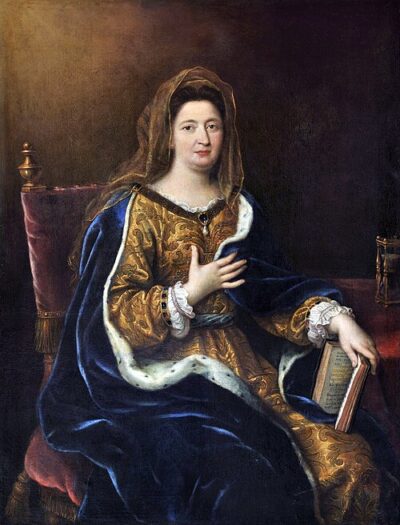
Françoise d'Aubigné, Marquise de Maintenon
Françoise d'Aubigné, Marquise de Maintenon was a Mistress and later secret wife of King Louis XIV of France. Born November 27, 1635, in Niort. Died April 15, 1719, in Palace of Versailles.
Facts
18 facts · 2 confirmed by two sources · 6 cited · 10 from one source
Where this comes from
Papalocal keeps its own record. It started from these sources; what each one said is kept here as it was copied, so a change on their side never changes this page by itself. Tap one to read its version.
What Wikidata says · copied November 16, 2026 · revision 2567489325
- Described as
- Mistress and later secret wife of King Louis XIV of France (1635-1719)
- Other names
- Françoise d'Aubigné, Marquise de Maintenon et du Parc, Françoise d' Aubigné, Madame de Maintenon, Francisca De Aubigné y de Cardilhac, Francisca de Aubigné y de Cardilhac, Francisca de Aubigne, Françoise d', marquise de Maintenon Aubigné, Francisca de Aubigne y de Cardilhac, Francisca de Aubigné y De Cardilhac, Madame De Maintenon, Françoise Scarron, Frances d'Aubigné Marchioness de Maintenon
- Born
- November 27, 1635 · 8 references
- Died
- April 15, 1719 · 8 references
- Born in
- Niort · 1 reference
- Died in
- Palace of Versailles
- Buried in
- Maison royale de Saint-Louis
- Name at birth
- Françoise d'Aubigné
- Citizen of
- France
- Occupation
- salonnière; correspondent; philosopher; dancer · 1 reference
- Spouse
- Louis XIV of France (1683–1715) · 2 references; Paul Scarron (1651–1660) · 1 reference
- Father
- Constant d'Aubigné · 1 reference
- Mother
- Jeanne de Cardillac · 1 reference
- Siblings
- Constant d'Aubigné; Charles d'Aubigné, d'Aubigné
- Religion
- Catholicism
- Wikipedias with a page
- 46
Wikidata item Q230670 (wikidata.org/wiki/Q230670), public domain (CC0). Copied November 16, 2026.
What Wikipedia says · copied November 16, 2026 · revision 1381388644
Françoise d'Aubigné (27 November 1635 – 15 April 1719), known first as Madame Scarron and subsequently as Madame de Maintenon (French: [madam də mɛ̃t(ə)nɔ̃] ), was a French noblewoman and the second wife of King Louis XIV from 1683 until his death in 1715. Although she was never considered queen of France, as the marriage was carried out in secret, Madame de Maintenon had considerable political influence as one of the King's closest advisers and the governess of the royal children.
Born into an impoverished Huguenot noble family, Françoise married the poet Paul Scarron in 1652, which allowed her access to the Parisian high society. She was widowed in 1660, but later saw her fortunes improve through her friendship with Louis XIV's mistress, Madame de Montespan, who tasked her with the upbringing of the king's extramarital children. She was made royal governess when the children were legitimised, and in 1675 Louis XIV granted her the title Marquise de Maintenon. By the late 1670s, she had essentially supplanted Montespan as the king's maîtresse-en-titre.
After the death of Queen Maria Theresa in 1683, Madame de Maintenon married Louis in a private ceremony. She came to be regarded as the second most powerful person in France, and her piety had a strong influence on her husband, who became firmer in his Catholic faith and had no more known mistresses. In 1686, she founded the Maison royale de Saint-Louis, a school for girls from impoverished noble families, which had a significant influence on female education under the Ancien Régime. After Louis XIV's death in 1715, Madame de Maintenon retired to Saint-Cyr, where she died four years later at the age of 83.
- Born, in its opening lines
- November 27, 1635
- Died, in its opening lines
- April 15, 1719
From the Wikipedia article “Françoise d'Aubigné, Marquise de Maintenon” (en.wikipedia.org/wiki/Françoise_d'Aubigné,_Marquise_de_Maintenon), by its contributors, under CC BY-SA 4.0 (creativecommons.org/licenses/by-sa/4.0/). Copied November 16, 2026; not changed.
Confirmed Two sources agree. Cited One source, and it names where it got it. One source One source, without a reference of its own. Sources disagree The sources disagree. We show the best-supported value and keep theirs below.
