
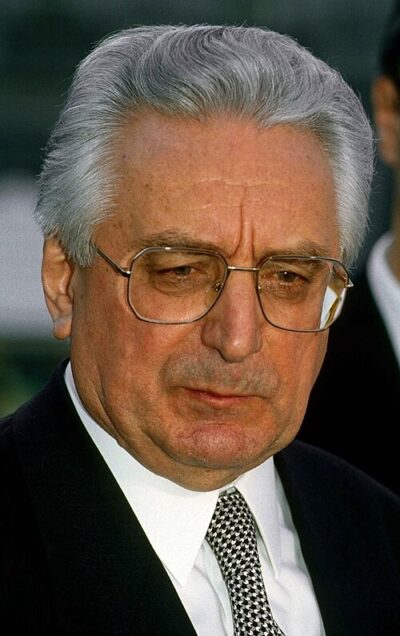
Franjo Tuđman
Franjo Tuđman was a Croatian politician, soldier, president and historian. Born May 14, 1922, in Veliko Trgovišće. Died December 10, 1999, in Zagreb. Positions held include representative in the Croatian Parliament. Educated at Military Academy Belgrade and University of Zadar. Awards include Zhukov Medal, Grand Order of King Tomislav and Order of Ante Starčević.
Facts
44 facts · 2 confirmed by two sources · 4 cited · 38 from one source
Where this comes from
Papalocal keeps its own record. It started from these sources; what each one said is kept here as it was copied, so a change on their side never changes this page by itself. Tap one to read its version.
What Wikidata says · copied November 16, 2026 · revision 2565559422
- Described as
- Croatian politician, soldier, president and historian (1922–1999)
- Other names
- Franjo Tudman, Franjo Tudjman
- Born
- May 14, 1922 · 8 references
- Died
- December 10, 1999 · 4 references
- Born in
- Veliko Trgovišće
- Died in
- Zagreb · 2 references
- Buried in
- Mirogoj Cemetery
- Cause of death
- cancer
- Citizen of
- Kingdom of Serbs, Croats and Slovenes; Kingdom of Yugoslavia; Socialist Federal Republic of Yugoslavia; Croatia
- Occupation
- politician · 1 reference; political commissar; university teacher; historian · 1 reference
- Positions held
- representative in the Croatian Parliament
- Political party
- Croatian Democratic Union; League of Communists of Yugoslavia; League of Communists of Croatia · 1 reference
- Worked for
- Croatian Institute of History; Faculty of Political Sciences in Zagreb
- Education
- Military Academy Belgrade; University of Zadar
- Member of
- Croatian Academy of Sciences and Arts
- Awards
- Zhukov Medal; Grand Order of King Tomislav; Order of Ante Starčević; Grand Order of Queen Jelena; Grand Order of King Petar Krešimir IV; Grand Order of King Dmitar Zvonimir; Order of Duke Trpimir; Order of Military Merit with large star; Order of the Partisan Star; Commemorative Medal of the Partisans of 1941; Order of the Liberator General San Martín; Knight Grand Cross of the Military Order of Italy; Grand Cross of the Order of the Redeemer; Order of State of Republic of Turkey; Order of Merit
- Spouse
- Ankica Tuđman
- Children
- Miroslav Tuđman · 1 reference
- Military branch
- Armed Forces of the Republic of Croatia
- Military rank
- major general; vrhovnik
- Website
- https://www.tudjman.hr/
- Wikipedias with a page
- 77
Wikidata item Q183703 (wikidata.org/wiki/Q183703), public domain (CC0). Copied November 16, 2026.
What Wikipedia says · copied November 16, 2026 · revision 1383387247
Franjo Tuđman (14 May 1922 – 10 December 1999) was a Croatian politician and historian who became the first president of Croatia, from 1990 until his death in 1999. He served following the country's independence from Yugoslavia. Tuđman also was the ninth and last president of the Presidency of SR Croatia from May to July 1990.
Tuđman was born in Veliko Trgovišće. In his youth, he fought during World War II as a member of the Yugoslav Partisans. After the war, he took a post in the Ministry of Defence, later attaining the rank of major general in 1960, and he was the youngest general ever of the Yugoslav People's Army. After his military career, he dedicated himself to the study of geopolitics. In 1963, he became a professor at the Zagreb Faculty of Political Sciences. He received a doctorate in history in 1965 and worked as a historian until coming into conflict with the regime. Tuđman participated in the Croatian Spring movement that called for reforms in the country, and was imprisoned for his activities in 1972. He lived relatively anonymously in the following years until the end of communism, whereupon he began his political career by founding the Croatian Democratic Union (HDZ) in 1989.
HDZ won the first Croatian parliamentary elections in 1990, and Tuđman became the President of the Presidency of SR Croatia. As president, Tuđman introduced a new constitution and pressed for the creation of an independent Croatia. On 19 May 1991, an independence referendum was held, which was approved by 93 percent of voters. Croatia declared independence from Yugoslavia on 25 June 1991. Areas with a Serb majority revolted, backed by the Yugoslav Army, and Tuđman led Croatia during its War of Independence. A ceasefire was signed in 1992, but the war had spread into Bosnia and Herzegovina, where Croats fought in an alliance with Bosniaks. Their cooperation fell apart in late 1992 and Tuđman's government sided with Herzeg-Bosnia during the Croat-Bosniak War, a move that brought criticism from the international community. In a final verdict of a war crimes trial of former high-ranking officials of Herceg-Bosnia, the ICTY stated that Tuđman shared in their joint criminal enterprise aimed at establishing a Croat territorial entity in Bosnia and Herzegovina, which was to be implemented in part through the ethnic cleansing of Bosniaks, with the aim of enabling its eventual unification with Croatia. However, it did not find him guilty of any specific crimes.
In March 1994, Tuđman signed the Washington Agreement with Bosnian President Alija Izetbegović that re-allied Croats and Bosniaks. In August 1995, he authorized a major offensive known as Operation Storm which effectively ended the war in Croatia. In the same year, he was one of the signatories of the Dayton Agreement that put an end to the Bosnian War. He was re-elected president in 1992 and 1997 and remained in power until his death in 1999. While supporters point out his role in achieving Croatian independence, critics have described his presidency as authoritarian. Surveys after Tuđman's death have generally shown a high favorability rating among the Croatian public.
- Born, in its opening lines
- May 14, 1922
- Died, in its opening lines
- December 10, 1999
From the Wikipedia article “Franjo Tuđman” (en.wikipedia.org/wiki/Franjo_Tuđman), by its contributors, under CC BY-SA 4.0 (creativecommons.org/licenses/by-sa/4.0/). Copied November 16, 2026; not changed.
Confirmed Two sources agree. Cited One source, and it names where it got it. One source One source, without a reference of its own. Sources disagree The sources disagree. We show the best-supported value and keep theirs below.
