
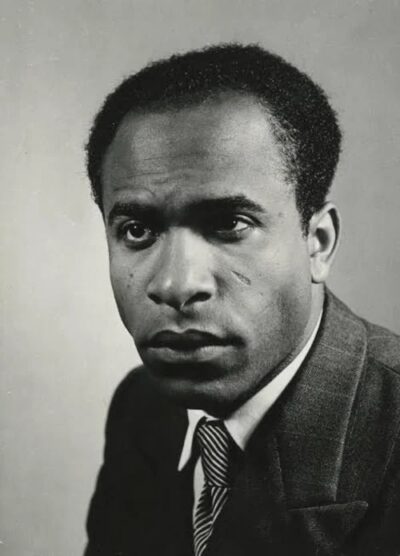
Frantz Fanon
Frantz Fanon was a French West Indian psychiatrist and philosopher. Born July 20, 1925, in Fort-de-France. Died December 6, 1961, in Bethesda. Known for The Wretched of the Earth, A Dying Colonialism and Black Skin, White Masks. Educated at University of Lyon.
Facts
22 facts · 2 confirmed by two sources · 10 cited · 10 from one source
Where this comes from
Papalocal keeps its own record. It started from these sources; what each one said is kept here as it was copied, so a change on their side never changes this page by itself. Tap one to read its version.
What Wikidata says · copied November 16, 2026 · revision 2568298566
- Described as
- French West Indian psychiatrist and philosopher (1925–1961)
- Other names
- Frantz Omar Fanon, Ibrahim Fanon, Ibrahim Omar Fanon, François Fanon
- Born
- July 20, 1925 · 11 references
- Died
- December 6, 1961 · 11 references
- Born in
- Fort-de-France · 1 reference
- Died in
- Bethesda · 1 reference
- Buried in
- Aïn Kerma
- Cause of death
- leukemia
- Occupation
- writer · 3 references; philosopher · 2 references; psychiatrist · 2 references; essayist; sociologist · 1 reference; politician · 2 references; physician · 1 reference
- Education
- University of Lyon
- Known for
- The Wretched of the Earth; A Dying Colonialism; Black Skin, White Masks
- Field
- philosophy; psychiatry · 1 reference
- Spouse
- Josie Fanon
- Children
- Mireille Fanon Mendès-France · 1 reference
- Website
- https://fondation-frantzfanon.com/
- Wikipedias with a page
- 75
Wikidata item Q193670 (wikidata.org/wiki/Q193670), public domain (CC0). Copied November 16, 2026.
What Wikipedia says · copied November 16, 2026 · revision 1384665752
Frantz Omar Fanon (, US: ; French: [fʁɑ̃ts fanɔ̃]; 20 July 1925 – 6 December 1961) was a French psychiatrist and political philosopher, who made critical contributions to the fields of post-colonial studies and critical theory. As well as an intellectual, Fanon was a political radical and Pan-Africanist, concerned with the psychopathology of colonization and the human, social, and cultural consequences of decolonization.
In the course of his work as a physician and psychiatrist, Fanon supported the Algerian War of independence (1954–1962) from France and joined the Algerian National Liberation Front. Jansen and Osterhammel characterise Fanon as "the most influential anticolonial thinker of his time". For more than five decades, the life and works of Fanon have inspired national liberation movements and other freedom and political movements in Sri Lanka, South Africa, and the United States.
Fanon formulated a model for community psychology, believing that many mental health patients would have an improved prognosis if they were integrated into their family and community instead of being treated with institutionalized care. He also helped found the field of institutional psychotherapy while working at Saint-Alban under François Tosquelles and Jean Oury.
- Born, in its opening lines
- July 20, 1925
- Died, in its opening lines
- December 6, 1961
From the Wikipedia article “Frantz Fanon” (en.wikipedia.org/wiki/Frantz_Fanon), by its contributors, under CC BY-SA 4.0 (creativecommons.org/licenses/by-sa/4.0/). Copied November 16, 2026; not changed.
Confirmed Two sources agree. Cited One source, and it names where it got it. One source One source, without a reference of its own. Sources disagree The sources disagree. We show the best-supported value and keep theirs below.
