
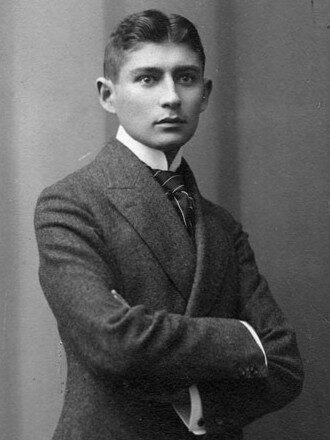
Franz Kafka
Franz Kafka was a Bohemian writer from Prague. Born July 3, 1883, in Prague. Died June 3, 1924, in Kafka Sterbehaus. Known for The Metamorphosis, The Trial and The Castle. Educated at German University in Prague and Charles University.
Facts
40 facts · 2 confirmed by two sources · 12 cited · 24 from one source · 2 where the sources disagree
What’s different
- Buried in: we show New Jewish Cemetery (Sources disagree). Wikidata also lists Grave of Franz Kafka
- Cause of death: we show laryngeal tuberculosis (Sources disagree). Wikidata also lists starvation
Where this comes from
Papalocal keeps its own record. It started from these sources; what each one said is kept here as it was copied, so a change on their side never changes this page by itself. Tap one to read its version.
What Wikidata says · copied November 16, 2026 · revision 2570083246
- Described as
- Bohemian writer from Prague (1883–1924)
- Other names
- Kafka, František Kafka
- Born
- July 3, 1883 · 26 references
- Died
- June 3, 1924 · 18 references
- Born in
- Prague · 9 references
- Died in
- Kafka Sterbehaus · 1 reference
- Buried in
- New Jewish Cemetery · 1 reference; Grave of Franz Kafka
- Cause of death
- laryngeal tuberculosis · 1 reference; starvation
- Name at birth
- Franz Kafka · 1 reference
- Citizen of
- Cisleithania (–1918); Czechoslovakia (1918–)
- Occupation
- novelist; fabulist; short story writer; aphorist; diarist; translator · 1 reference; lawyer · 1 reference; poet lawyer
- Worked for
- Assicurazioni Generali; Allgemeine Unfallversicherungsanstalt
- Education
- German University in Prague (1901–1906); Charles University · 1 reference; philosophy faculty of the German university of Prague · 1 reference; Faculty of Law, German University in Prague · 1 reference
- Genre
- modernism; belletristic literature; pritcha; short prose · 1 reference
- Known for
- The Metamorphosis; The Trial; The Castle; Before the Law; Lost in America
- Field
- literature · 1 reference; Prague German Literature · 1 reference
- Father
- Hermann Kafka
- Mother
- Julie Löwy
- Siblings
- Elli Kafka · 1 reference; Valli Kafka · 1 reference; Ottla Kafka · 2 references
- Lived in
- Prague
- Wikipedias with a page
- 242
Wikidata item Q905 (wikidata.org/wiki/Q905), public domain (CC0). Copied November 16, 2026.
What Wikipedia says · copied November 16, 2026 · revision 1385630854
Franz Kafka (3 July 1883 – 3 June 1924) was a German-language Jewish writer from Prague. Widely regarded as a major figure of 20th-century literature, his works fuse elements of realism and the fantastique, and typically feature isolated protagonists facing bizarre or surreal predicaments and incomprehensible bureaucratic powers. The term Kafkaesque has entered the lexicon to describe situations like those depicted in his writings. His best-known works include the novella The Metamorphosis (1915) and the novels The Trial (1925) and The Castle (1926). He is also celebrated for his brief fables and aphorisms, which frequently incorporated comedic elements alongside the darker themes of his longer works. His work has widely influenced artists, philosophers, composers, filmmakers, literary historians, religious scholars, and cultural theorists.
Kafka was born into a middle-class German-speaking family. He trained as a lawyer, and after completing his legal education was employed in various legal and insurance jobs. His professional obligations led to internal conflict, because he felt that his true vocation was writing. Only a minority of his works were published during his life: the story collections Contemplation (1912) and A Country Doctor (1919), and individual stories, such as his novella The Metamorphosis, were published in literary magazines, but they received little attention. He wrote hundreds of letters to family and close friends, including his father, with whom he had a strained and formal relationship. He became engaged to several women but never married. He died relatively unknown in 1924 of tuberculosis, aged 40. His literary executor and friend Max Brod ignored Kafka's wishes to destroy his remaining works, publishing them to eventual acclaim.
- Born, in its opening lines
- July 3, 1883
- Died, in its opening lines
- June 3, 1924
From the Wikipedia article “Franz Kafka” (en.wikipedia.org/wiki/Franz_Kafka), by its contributors, under CC BY-SA 4.0 (creativecommons.org/licenses/by-sa/4.0/). Copied November 16, 2026; not changed.
Confirmed Two sources agree. Cited One source, and it names where it got it. One source One source, without a reference of its own. Sources disagree The sources disagree. We show the best-supported value and keep theirs below.
