
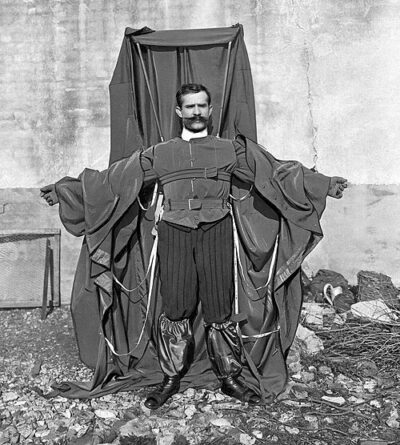
Franz Reichelt
Franz Reichelt was an Austro-Hungarian-born French parachuting pioneer. Born October 16, 1878, in Štětí. Died February 4, 1912, in 7th arrondissement of Paris. Educated at Thomas Mann Gymnasium.
Facts
13 facts · 2 confirmed by two sources · 5 cited · 6 from one source
Where this comes from
Papalocal keeps its own record. It started from these sources; what each one said is kept here as it was copied, so a change on their side never changes this page by itself. Tap one to read its version.
What Wikidata says · copied November 16, 2026 · revision 2569039975
- Described as
- Austro-Hungarian-born French parachuting pioneer
- Other names
- Franz Karl Reichelt, Henry François Reichelt, Reichelt, Franz
- Born
- October 16, 1878 · 1 reference
- Died
- February 4, 1912 · 1 reference
- Born in
- Štětí · 1 reference
- Died in
- 7th arrondissement of Paris
- Cause of death
- falling
- Name at birth
- Franz Karl Reichelt · 1 reference
- Citizen of
- Cisleithania; France (1909–)
- Occupation
- tailor · 1 reference; inventor; design engineer · 1 reference; skydiver · 1 reference
- Education
- Thomas Mann Gymnasium
- Wikipedias with a page
- 32
Wikidata item Q112070 (wikidata.org/wiki/Q112070), public domain (CC0). Copied November 16, 2026.
What Wikipedia says · copied November 16, 2026 · revision 1382719715
Franz Reichelt (16 October 1878 – 4 February 1912), also known as Frantz Reichelt or François Reichelt, was an Austro-Hungarian-born French tailor, inventor and parachuting pioneer, now sometimes referred to as the Flying Tailor. He is remembered for jumping to his death from the Eiffel Tower while testing a wearable parachute of his own design, a device that today might be called a wingsuit. Reichelt had become fixated on developing a suit for aviators that would convert into a parachute and allow them to survive a fall should they be forced to leave their aircraft in mid-air. Initial experiments conducted with dummies dropped from the fifth floor of his apartment building had been successful, but he was unable to replicate those early successes with any of his subsequent designs.
Believing that a suitably high test platform would prove his invention's efficacy, Reichelt repeatedly petitioned the Parisian Prefecture of Police for permission to conduct a test from the Eiffel Tower. He finally received permission in 1912, but when he arrived at the tower on 4 February he made it clear that he intended to jump personally rather than conduct an experiment with dummies. Despite attempts to dissuade him, he jumped from the first platform of the tower wearing his invention. The parachute failed to deploy, and he plummeted 57 metres (187 ft) to his death. The next day, newspapers were full of illustrated stories about the death of the "reckless inventor." It was captured on film and then showcased in newsreels, making it the first accidental death captured on film.
- Born, in its opening lines
- October 16, 1878
- Died, in its opening lines
- February 4, 1912
From the Wikipedia article “Franz Reichelt” (en.wikipedia.org/wiki/Franz_Reichelt), by its contributors, under CC BY-SA 4.0 (creativecommons.org/licenses/by-sa/4.0/). Copied November 16, 2026; not changed.
Confirmed Two sources agree. Cited One source, and it names where it got it. One source One source, without a reference of its own. Sources disagree The sources disagree. We show the best-supported value and keep theirs below.
