
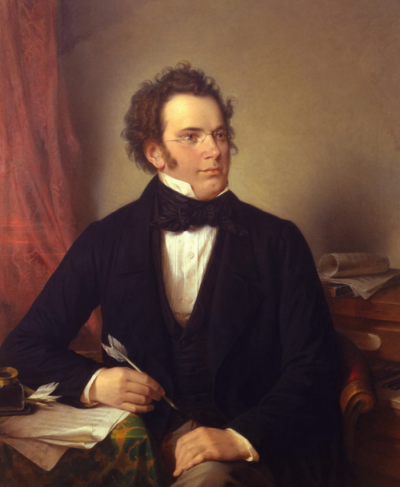
Franz Schubert
Franz Schubert was an Austrian composer. Born January 31, 1797, in Himmelpfortgrund. Died November 19, 1828, in Vienna. Known for Symphony No. 8, Symphony No. 9 and Symphony No. 3. Educated at University of Music and Performing Arts Vienna and Akademisches Gymnasium.
Facts
33 facts · 2 confirmed by two sources · 5 cited · 26 from one source
Where this comes from
Papalocal keeps its own record. It started from these sources; what each one said is kept here as it was copied, so a change on their side never changes this page by itself. Tap one to read its version.
What Wikidata says · copied November 16, 2026 · revision 2566305340
- Described as
- Austrian composer (1797–1828)
- Other names
- Schubert, Franz Peter Schubert
- Born
- January 31, 1797 · 20 references
- Died
- November 19, 1828 · 17 references
- Born in
- Himmelpfortgrund · 1 reference
- Died in
- Vienna · 2 references
- Buried in
- Vienna Central Cemetery
- Cause of death
- typhoid fever · 1 reference
- Name at birth
- Franz Peter Schubert
- Citizen of
- Austrian Empire; Archduchy of Austria
- Occupation
- composer · 2 references; pianist; teacher · 1 reference
- Education
- University of Music and Performing Arts Vienna; Akademisches Gymnasium
- Genre
- classical music
- Instrument
- piano; violin
- Known for
- Symphony No. 8; Symphony No. 9; Symphony No. 3; Winterreise; Death and the Maiden; Ellens dritter Gesang
- Field
- music · 1 reference; music composing · 1 reference; piano music · 1 reference
- Father
- Franz Theodor Schubert
- Siblings
- Ferdinand Schubert; Karl Schubert; Maria Theresia Schubert; Anton Eduard Schubert · 1 reference; Ignaz Schubert · 1 reference; Andreas Theodor Schubert · 1 reference
- Wikipedias with a page
- 174
Wikidata item Q7312 (wikidata.org/wiki/Q7312), public domain (CC0). Copied November 16, 2026.
What Wikipedia says · copied November 16, 2026 · revision 1382121192
Franz Peter Schubert (; German: [fʁants ˈpeːtɐ ˈʃuːbɐt]; 31 January 1797 – 19 November 1828) was an Austrian composer of the late Classical and early Romantic eras. He was immensely prolific despite living a short life, leaving behind a vast oeuvre of more than 1,000 compositions, including over 600 Lieder (art song in German) and other vocal works, seven complete symphonies, sacred music, operas, incidental music, and a large body of piano and chamber music. Among these are the songs "Gretchen am Spinnrade", "Erlkönig" and "Ave Maria"; the Trout Quintet; the Symphony in B minor, "Unfinished"; the Symphony in C major, "The Great"; the String Quartet No. 14 in D minor (Death and the Maiden); the String Quintet in C major; the Impromptus for solo piano; the last three piano sonatas; the Fantasia in F minor for piano four hands; the incidental music to the play Rosamunde; the song cycles Die schöne Müllerin and Winterreise; and the song collection Schwanengesang.
Born in the Himmelpfortgrund suburb of Vienna, Schubert showed uncommon gifts for music from an early age. His father gave him his first violin lessons and his elder brother gave him piano lessons, but Schubert soon surpassed their abilities. In 1808, at the age of eleven, he became a pupil at the Stadtkonvikt school, where he became acquainted with the orchestral music of Joseph Haydn, Wolfgang Amadeus Mozart, and Ludwig van Beethoven. He left the Stadtkonvikt at the end of 1813 and returned home to live with his father, where he began studying to become a schoolteacher. Despite this, he continued his studies in composition with Antonio Salieri and still composed prolifically. In 1821, Schubert was admitted to the Gesellschaft der Musikfreunde as a performing member, which helped establish his name among the Viennese citizenry. He gave a concert of his works to critical acclaim in March 1828, the only time he did so in his career. He died eight months later at the age of 31, the cause officially attributed to typhoid fever, but believed by some historians to be syphilis.
Appreciation of Schubert's music while he was alive was limited to a relatively small circle of admirers in Vienna, but interest in his work increased greatly in the decades following his death. Felix Mendelssohn, Robert Schumann, Franz Liszt, Johannes Brahms and other 19th-century composers discovered and championed his works. Today, Schubert is considered one of the greatest composers in the history of Western classical music and his music continues to be widely performed.
- Born, in its opening lines
- January 31, 1797
- Died, in its opening lines
- November 19, 1828
From the Wikipedia article “Franz Schubert” (en.wikipedia.org/wiki/Franz_Schubert), by its contributors, under CC BY-SA 4.0 (creativecommons.org/licenses/by-sa/4.0/). Copied November 16, 2026; not changed.
Confirmed Two sources agree. Cited One source, and it names where it got it. One source One source, without a reference of its own. Sources disagree The sources disagree. We show the best-supported value and keep theirs below.
