
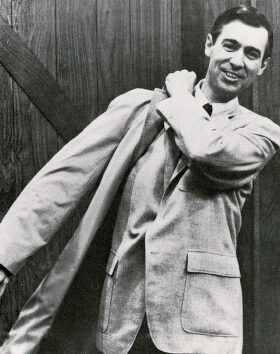
Fred Rogers
Fred Rogers was an American television personality. Born March 20, 1928, in Latrobe. Died February 27, 2003, in Pittsburgh. Educated at Dartmouth College and Rollins College. Awards include Presidential Medal of Freedom, Peabody Awards and Daytime Emmy Award.
Facts
30 facts · 2 confirmed by two sources · 7 cited · 21 from one source
Where this comes from
Papalocal keeps its own record. It started from these sources; what each one said is kept here as it was copied, so a change on their side never changes this page by itself. Tap one to read its version.
What Wikidata says · copied November 13, 2026 · revision 2568524983
- Described as
- American television personality (1928–2003)
- Other names
- Fred M. Rogers, Fred McFeely Rogers, Mister Rogers, Mr. Rogers
- Born
- March 20, 1928 · 3 references
- Died
- February 27, 2003 · 3 references
- Born in
- Latrobe · 1 reference
- Died in
- Pittsburgh · 1 reference
- Buried in
- Unity Cemetery · 1 reference
- Citizen of
- United States
- Occupation
- Christian minister; puppeteer · 1 reference; singer; author; composer; educator; screenwriter; songwriter
- Education
- Dartmouth College; Rollins College (1951); Thiel College; University of Pittsburgh; Pittsburgh Theological Seminary (1962); Greater Latrobe Senior High School
- Instrument
- piano; voice
- Awards
- Presidential Medal of Freedom (2002) · 1 reference; Peabody Awards (1992); Daytime Emmy Award; Library of Congress Living Legend (2000–) · 1 reference; star on Hollywood Walk of Fame · 1 reference
- Spouse
- Joanne Rogers
- Mother
- Nancy Flagg · 1 reference
- Religion
- Presbyterianism
- Wikipedias with a page
- 75
Wikidata item Q1275768 (wikidata.org/wiki/Q1275768), public domain (CC0). Copied November 13, 2026.
What Wikipedia says · copied November 13, 2026 · revision 1377744639
Fred McFeely Rogers (March 20, 1928 – February 27, 2003), also known professionally as Mister Rogers, was an American television personality, Presbyterian minister, and author. He was the creator, showrunner, and host of the preschool television series Mister Rogers' Neighborhood, which ran from 1968 to 2001.
Born in Latrobe, Pennsylvania, Rogers earned a bachelor's degree in music from Rollins College in 1951. He began his television career at NBC in New York City, returning to Pittsburgh in 1953 to work for children's programming at NET (later PBS) television station WQED. He graduated from Pittsburgh Theological Seminary with a bachelor's degree in divinity in 1962 and became a Presbyterian minister in 1963. He attended the University of Pittsburgh's Graduate School of Child Development, where he began his thirty-year collaboration with child psychologist Margaret McFarland. He also helped develop the children's shows The Children's Corner (1955) for WQED in Pittsburgh and Misterogers (1963) in Canada for the Canadian Broadcasting Corporation. In 1968, he returned to Pittsburgh and adapted the format of his Canadian series to create Mister Rogers' Neighborhood. It ran for 33 years and was critically acclaimed for focusing on children's emotional and physical concerns, such as death, sibling rivalry, school enrollment, and divorce.
Rogers died of stomach cancer in 2003, aged 74. His work in children's television has been widely lauded, and he received more than forty honorary degrees and several awards, including a Lifetime Achievement Emmy in 1997 and the Presidential Medal of Freedom in 2002. He was inducted into the Television Hall of Fame in 1999. Rogers influenced many writers and producers of children's television shows, and his broadcasts provided comfort during incidents, even after his death.
- Born, in its opening lines
- March 20, 1928
- Died, in its opening lines
- February 27, 2003
From the Wikipedia article “Fred Rogers” (en.wikipedia.org/wiki/Fred_Rogers), by its contributors, under CC BY-SA 4.0 (creativecommons.org/licenses/by-sa/4.0/). Copied November 13, 2026; not changed.
Confirmed Two sources agree. Cited One source, and it names where it got it. One source One source, without a reference of its own. Sources disagree The sources disagree. We show the best-supported value and keep theirs below.
